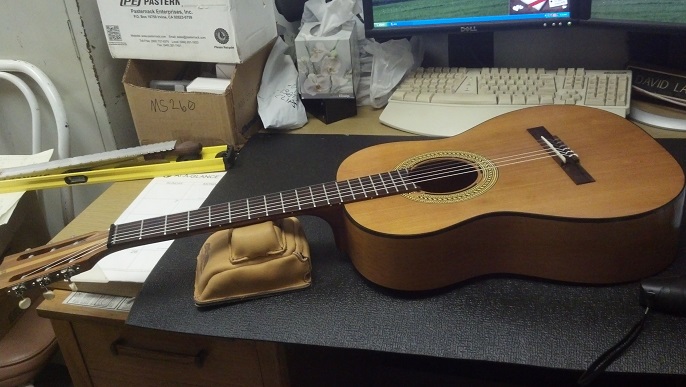
Luna Gypsy Spalted Acoustic Guitar Needs Fretwork

Sophia of “Pretty In Punk” purchased this guitar new, but it was almost unplayable. Could the Unbrokenstring Crew get this beautiful instrument in shape?

Nearly every fret was higher or lower than the one next to it.  To mask the problem, the action was very high.

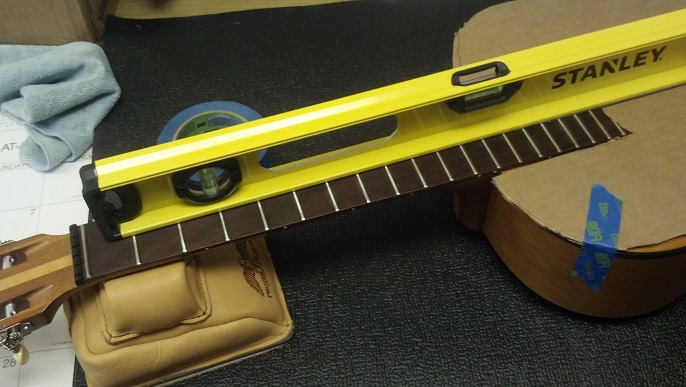
We straightened the neck itself so that it was absolutely flat, then used the Absolutely Flat sander across the frets.

Here, you can see the large amount of material removed from one fret, but not the others.

More material removed from the high frets.

Oh, look, here is another high fret.

Here, three frets in a row were high.

Getting close to the sound board, we’re running out of high frets to sand.

After sanding, we marked the top edge of the frets so we don’t take any more material from them.

This nifty fret file works only on the sides of the fret to round them over.  This file was reviewed in an earlier blog post.

Now, we’re getting somewhere.  This fret board is flat and the frets are even.

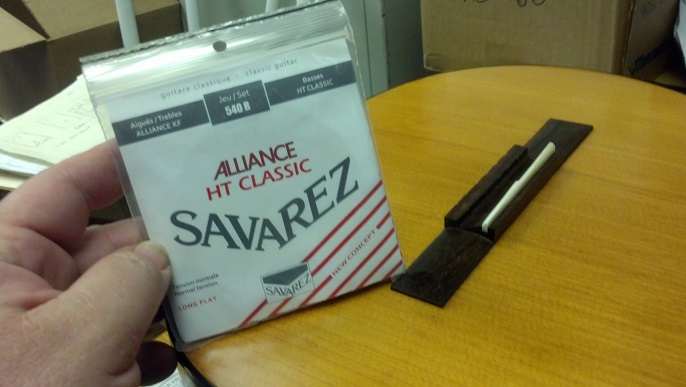
Sophia prefers these strings.

If you look closely, some of the over-wound strings at the end almost crested the top of the saddle.  If they get too close, I have some washers that slip over the string and sit on the ball end.  The string would then be passed thru the hole in the bridge from the inside of the guitar.  However, when tuned to standard pitch, we had no trouble here.  Missed It By That Much!


I think she’s happy with the results!

Thanks for reading all the way to the end!

CONTACT – David Latchaw EE
281-636-8626

Breedlove 12 String Breaks Strings

I saw Leo Kottke in concert on a Thursday evening in 1975.  The next day, I gave up on the guitar solely because I felt so overwhelmed by his talent and felt unworthy to ever touch a guitar again. Confronting my sick, twisted fears from that traumatic experience included resuming my music studies thirty-five years later.  Doing her part to attack my illness, my Darling Bride, who went with me on that fateful night, purchased this Korean-made Breedlove Stage Concert guitar for me.

In standard tuning, the high G string broke more often than not. What to do?  I started by re-chamfer and polishing the edge of the hole in the tuner where the string passes.  The breaks appear to occur when the G string passes across the hole in the tuner.  When the string passes across the hole, a stress concentration could occur right at the chamfer.


Here is a bit copied out of my Breedlove’s Owners Manual.  The stock high G string is 0.008 inch.


These came from Strings By Mail. Many individual strings can be purchased ala-carte from them.


My plan is to throw conventional wisdom to the wind and add enough string to the post so that the portion of the string leaving the post only touches the round portion of the post, not the hole nor its chamfer.  Here, I am measuring the broken string to establish where the stress concentration occurred.


Then I added the length of the string that was broken off, then estimated the circumference of the hourglass-shaped tuning post and multiplied times 12.  The plan is to get enough static string on the post to cover the hole, preventing the portion of the string leaving the post on a tangent from getting anywhere near the hole.  Putting more than three or four wraps of string around a tuning post is generally frowned on, because the more string wound on the post, the longer it takes for the tuning to stabilize.  We’ll see…


I love the bridge on my Breedlove.  I don’t have to reach inside the guitar to push the bridge pegs out nor verify that the ball ends are up against the peg and bottom of the sound board..


The ala-carte strings have ball ends that do not necessarily match the color codes used in the sets.  Who would notice??


I polished and chamfered the hole edge to the best of my ability.


To keep the loose string end under control while fiddling with the length of the new string, I put my classical guitar capo across the neck to corral the G string.


Here’s the G string.  I can grab it, pull it, handle it, measure it, trim it, pull it, and it won’t get away from me.


I estimated the additional string length in a previous step, and am adding it here.


We have all been here.  Wish me luck!


Here is eleven turns of the G string around the post.  Uh oh.  I am a little short of covering the hole.


But, tuned up to pitch, the portion of the string that tangentially leaves the tuning post is no where near the hole.


Here is another view, showing the smooth transition from the last wrap.  I don’t think we will see the sharp bend in the portion of the string that leaves the tuning post tangentially that would occur if the guitar were tuned and the string were bent over the edge of the hole in the tuner.

My original goal was to load up the tuning post with enough string to cover the hole entirely, thus eliminating the chance that the portion of the string leaving on a tangent toward the nut would experience a sharp bend across the tuning post hole.  But, I lucked out this time, and now the string is no where near the hole.  Thus, I could have reduced the number of turns of string on the post.  Not too bad for my first investigation.

I have not broken the high G string on my 12 string guitar since these pictures were taken.  The high G string has stayed in tune while playing and does not appear to de-tune between sessions any more so than the other strings.

Thanks for reading all the way to the bottom!

CONTACT – David Latchaw EE
281-636-8626

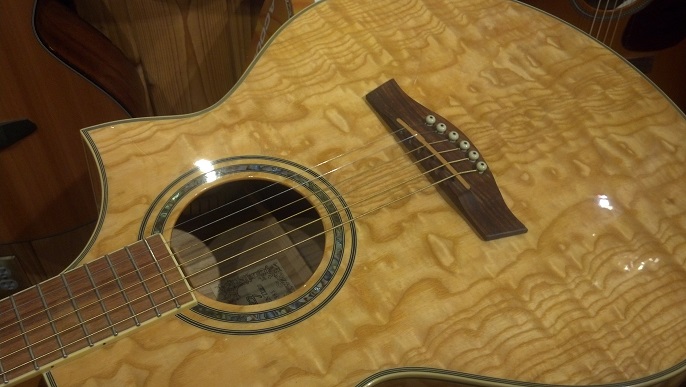
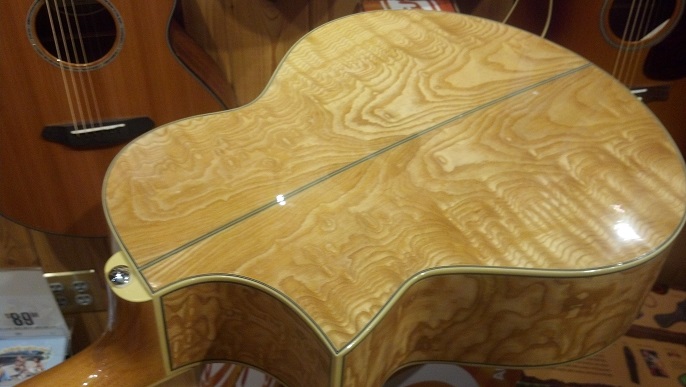
Plato de Golpeado On Highly-Figured Wood

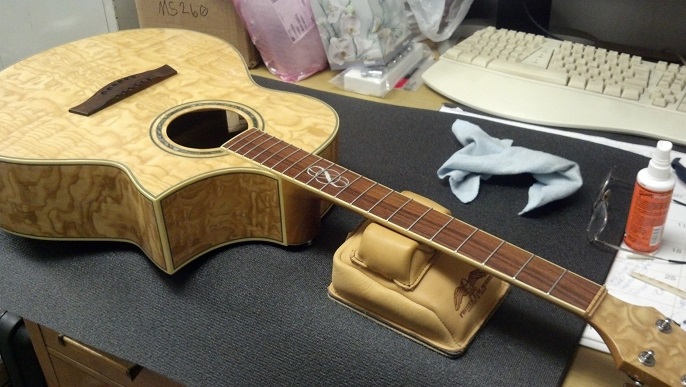
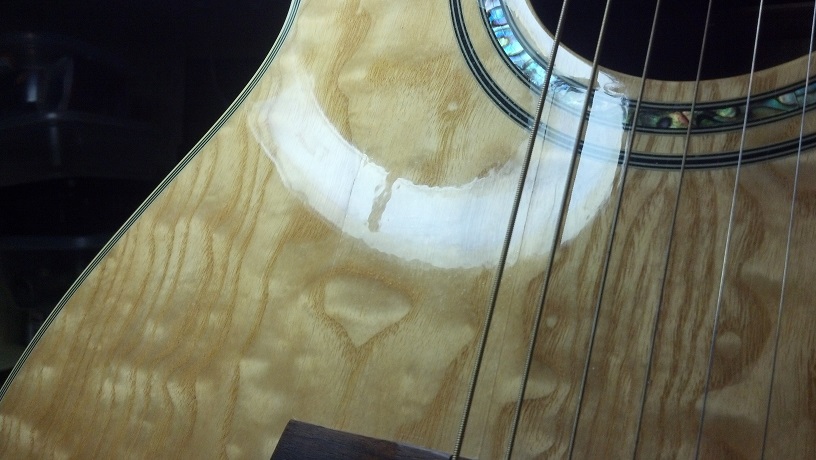
While lost in conversation with a friend, I picked up this guitar and started playing a few scales. The guitar was FANTASTIC!  Had I not been distracted, I never would have picked up such a presumptuous, pimped-out guitar. But this guitar will replace my stolen Rogue RD-80 acoustic.

I’m not too proud to show off the price tag. Minnie Pearl would be proud!

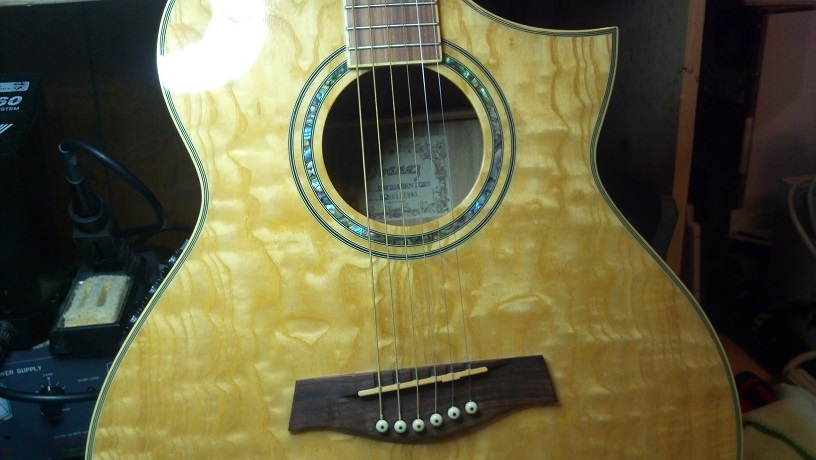
This thing is so flashy, traffic will pull off the road to let it drive by!

Eye candy all around!

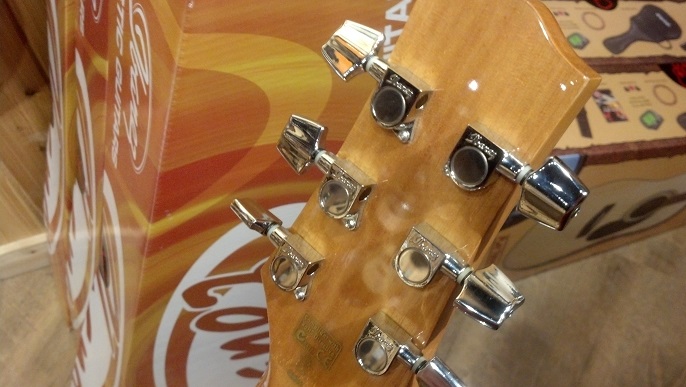
Even the head stock is done in figured wood and mother of pearl.

While we’re gawking, check out these tuners; Really nice for an inexpensive guitar.

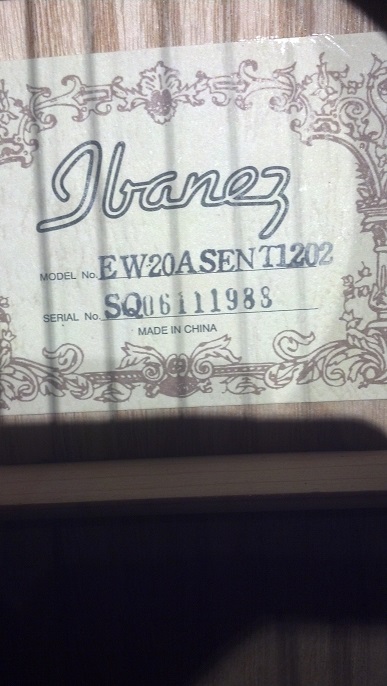
But, the darned thing was made in China. Gotta take the good with the bad.

Note that the nut is stepped, not uncommon on Ibanez guitars.

The intonated saddle is apparently made of the same stuff as the nut.  Ibanez calls this “Ivorex II”

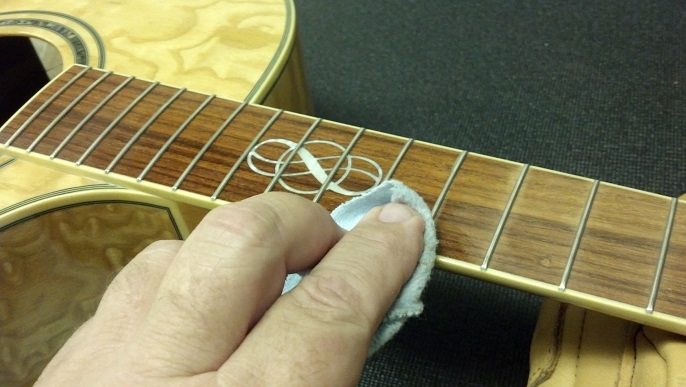
My bride purchased this guitar. I took it home and did a setup. The fret board was as dry as the Sahara.

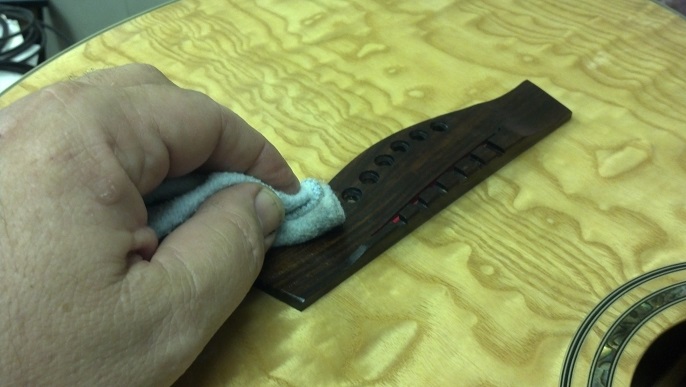
Likewise, the bridge hadn’t seen much care in a few years.

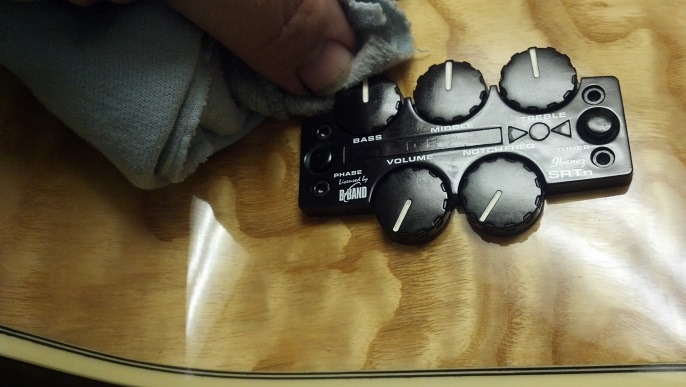
The previous owner was a smoker. Everything was covered with nicotine.

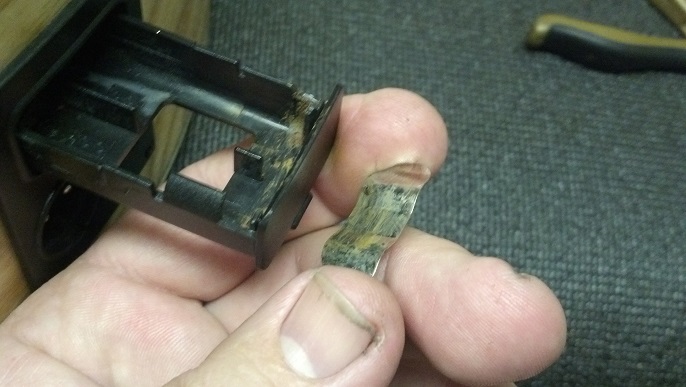
Something else that hadn’t seen much care in the last few years was the battery compartment.

The battery box needed a big clean-up.

Let’s string it up!

Among flamenco enthusiasts, the plato de golpeado, or tap plate, protects the sound board of the guitar from the finger taps, or golpes, a rhythmic percussive element of flamenco music.

This guitar has no pick guard, and I don’t want to put a pick guard that would hide the view.  However, a clear tap plate may be just the ticket to protect the sound board.

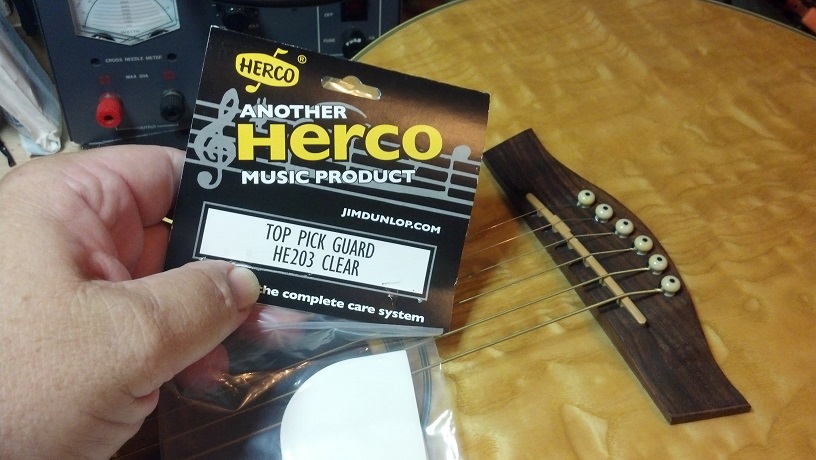
This product is a simple way to add a pick guard and not spoil the view.

A pair of scissors works this material easily.

Here is the other side cut to shape.  I rounded the corners to avoid sharp corners that would snag something.

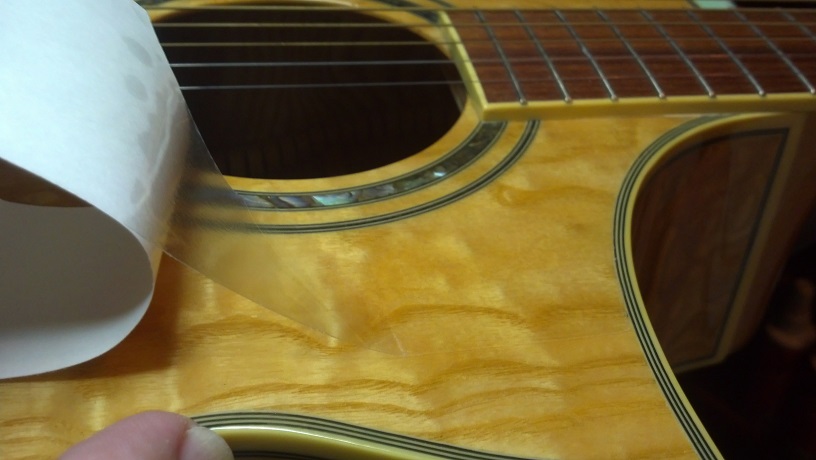
One end is stuck down, and the rest of the backing is removed.

Another view of the peel and stick process.

In this view, you can see tiny air bubbles under the pick guard.  We can burnish these away.

A lint-free rag and some elbow grease is necessary at this step.

That’s better!

Jen puts this wonderful guitar through its paces.  No pick scratches on this guitar’s sound board!

Here is another review:

And a little bit more about how this model sounds (mine sounds like this but I can’t play it as well…)

Thanks for reading to the end!

CONTACT : David Latchaw EE
281-636-8626

Gibson C-0 Classical Guitar Fret Dress

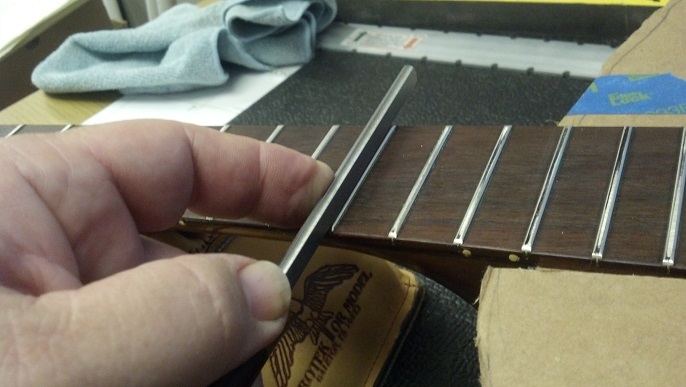
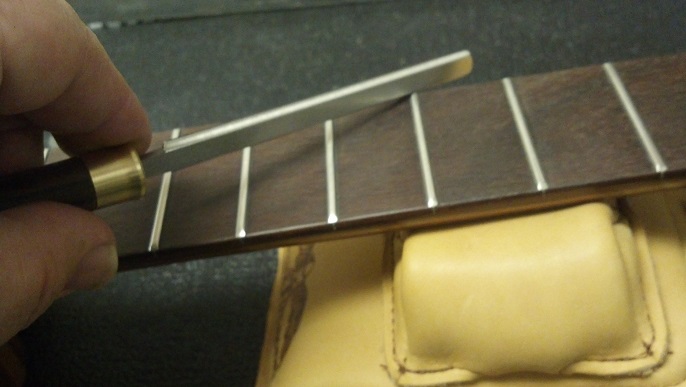
An interesting tool came in the mail from the good folks at Grizzly Tools. This file is polished smooth, with two quarter-round concave file surfaces on opposing corners. It can be used as an alternative to the traditional fret dressing file. Let’s try it out on my 1968 Gibson C-0 classical guitar, that was cleaned up in an earlier post but could still benefit from a thorough fret dressing.  (Photo courtesy of Stewart McDonald.)

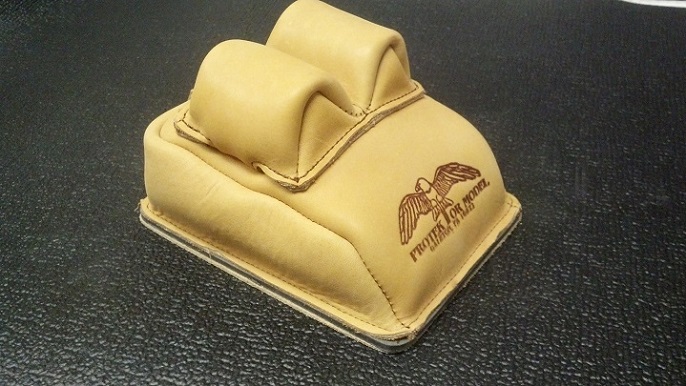
I’ve recently added a leather sandbag to my luthiere tool set. The little bunny ears really hold the neck securely. NOTE: Be Aware that this bag is sold as a rest for use at the gun range, but makes an awesome neck support.

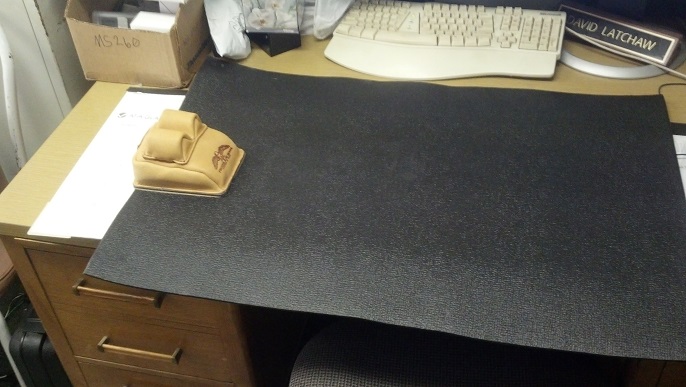
The mat is a section of a floor covering used in gyms.  These mats are often used underneath workout machines and in the free weight areas.  They are tough and plenty cushy, just the thing for your luthier’s workbench.  And one mat can be slit into enough pieces to outfit four or five guitar workstations.

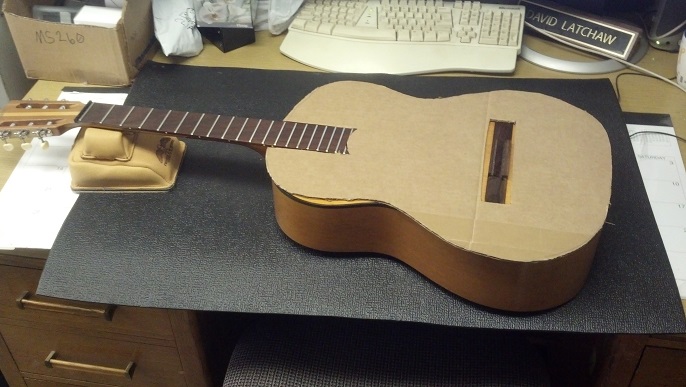
I covered the sound board with a sheet of corrugated cardboard. No sense in risking any damage to that fifty-year-old piece of cedar!  A pair of heavy-duty scissors is barely adequate for the job.

So here’s the cardboard sound board cover at work.  This will keep stuff out of the sound hole as well as help prevent gouging the guitar.

The frets are leveled with emery paper glued to this straight edge.

Here we are going to work with the new file. The file works best with the wide part of the blade vertical to the fret board when going along the length of the fret wire.  You can see a little black magic marker on the tops of each fret wire, which serves as a visual indicator on where (and where not) to remove material.

With this file, I did not feel it was necessary to tape off the fret board because the filed particles were not small enough to lodge in the grain of the rosewood. Also, the thickness of a layer of tape would have held the blade of the file away from the corners of the fret wire ends that needed to be dressed. The fret wires were very smooth after the filing was complete, so the fret polishing was almost trivial.

The creation of this saddle was documented in an earlier post. We’re ready to restring!

I can say that these strings are excellent! They are just a tiny bit smaller in diameter than the Augustine strings I had been using, and no intonation problems. These are a keeper!

Some customers wanted more pictures of how I tie off the classical guitar strings at the bridge tie block. Note that the ends of each string is tied underneath the loop of the string next to it.  I start at string one (high E) and then secure the end in the loop of the next lower string.  This looks neat and really assures me that the knot will not come loose and the string come untied.

Here, I’m taking my time to show how the last string (string six or low E) is tied off.  The direction of the wrap forming the loop is in the opposite direction of the wrap used on the higher strings.  This causes the free end of the E string to ‘point’ in the direction of the A string, in whose loop it shall be secured.

Now the knots in both strings are pulled tight. You can now see how the A string really holds everything in place.  The end of the A string projects through the loop of string six (the low E.)  We’re done here.

As I work on this guitar more and more, it gets better and better. These new strings sound wonderful. Leveling and dressing the frets make every note crisp and clean all the way up and down the fret board. The Grizzly fret file is a keeper!

Thanks for reading all the way to the end!


CONTACT: David Latchaw EE

281-636-8626

Yamaha G240 Classical Guitar Refurb

Donny mentioned that this beautiful 1970s era Yamaha needed a set of strings.  Turns out, it could use a little TLC.  The Unbrokenstring Crew steps up to the plate to bring this classical guitar up to speed!


Intended as a student guitar, these wonderful old Yamaha guitars rival many medium priced guitars found today.


The serial number is hand-stamped on a soundboard brace.


At the time, we considered Made In Taiwan as junk.  Nowadays, that was the Good Stuff!  How times change…


Obviously the nut is unglued, but note that the rosewood fingerboard had been painted black, to give the appearance of ebony.  Such was the snobbery found in the classical guitar world back in the 1970’s.  My first classical guitar sported a black painted fingerboard, and it looked a lot like this after years of playing.  Nothing to be ashamed of nowadays.  In another fifty years, we’ll be playing guitars with synthetic Richlite fingerboards, and consider rosewood fingerboards as ‘high end’ and collectible.


This diamond file is removing the old glue and truing up the gluing surface on the neck.


The diamond file is working on the end grain of the fingerboard.  That little cavity under the nut is not for a truss rod, but rather appears to be a slot for a stiffener of some sort.  Classical guitars seldom use truss rods to counteract string tension, as nylon string tension is about a third of the tension created by steel strings.


Any glue remaining on the nut itself comes off using the mill file.


Some alcohol on a rag cleans off residue on the nut.


Time to clear out the old DNA and tune up the string slots in the nut.


This is a serrated wire used to clean orifices on cutting torch tips.  They are often re-sold for many times the price by companies servicing the luthier craft.  Just get yours from the car parts store or a good tool store.


The tip cleaners come in many sizes, so just use a micrometer to select the correct size for your application.  Here, I’ve moved to the B string.  The rest of the slots are clean and smooth, so I’m done here once this slot is smooth.


Looks good!  We’re ready for some hide glue.  But how do I clamp it down?


How about using a couple of the old strings, brought up to tension, to keep the nut in place for a day or so?


This guitar was missing the saddle.  Here, I’m shaping a piece of Vietnamese water buffalo bone on the belt sander.


The water buffalo bone is incredibly hard, a natural material, and a renewable resource as opposed to ivory.  Some of the new synthetics are good, but I have this in stock and I love grossing out the other Unbrokenstring Crew members.  Bone? Dead animals?  Yuck!


The Yamaha saddle is about 0.100 inch thick.  These blanks are about 0.140 inch thick to start.  After a few minutes, I’m down to 0.137 inch.


We are at 0.131 inch.


Down to 0.121 inch.


Can you read this one?  0.115 inch.


Almost there!  We’re at 0.103 inch thick.


As George Bush would say, we have destinated!


The trial-fit part of our program is complete.  Note that the saddle is a little long.  There is a method in my madness here.  Let me introduce you to a real luthier who can explain what I’m trying to accomplishing here:

Q: Why do the British like Lucas refrigerators?

A: Because they like warm beer.

Seriously, the last thing I want to use on a fine musical instrument is lubricant that oxidizes and turns into gum.  Synthetic lubricants don’t oxidize, and so make a better choice when metal-to-metal lubrication is needed.  Such as in tuning machines.  This Lucas product is thick enough to stay in place when assembling engines.  This lubricant will stay in place on a musical instrument.


I need to install some strings in order to set the action at the twelfth fret.  Before I do much more with these tuning machines, I will lubricate them and set the gear mesh so that the guitar will stay in tune yet the tuners will run smoothly.


I re-used a couple of the old strings to accomplish the string height setup.  One of them has a ball end!


Stupid Me.  The old strings were worn and did not have a constant cross section.  Thus, I got weird, inconsistent readings.  I’ll use a new string.


Same with the high E string.  A new string is pressed into service in order to complete the setup.


The top edge of the saddle will be rounded off in order to remove any sharp edges that may cut the strings.  A rounded top edge also allows a single point to support the string, resulting in better sustain.


Now that we have the saddle to the proper dimensions, every surface will be polished with a high speed buffer.


The bottom edge of the saddle blank gets special attention.  Here the blank is set level with the jaws of the vise.  The jaws will act as a guide to keep everything straight and true.  A polished, flat surface against the bridge will permit the best transfer of energy from the strings to the soundboard.  The variation in color in this piece of bone is due to the changes in orientation of the grain of the calcium in the bone.  This gives an almost opalescent appearance to the saddle.


The top of the blank is polished, yielding a hard surface to support the strings.  Note that this end of the blank is curved.  This marks the orientation of the saddle; the rounded end points in the direction of string 1 (high E.)


The faces of the saddle are polished as well, mainly for appearance.  Note again the presence of the calcium grain.


Time to string it up.  Here you can see the wedge shape of the saddle, which allows the user to set the action height.


All laced up!  The free end of the adjacent string is secured in the loop of the next string over.  I’ve never had to retie a string or tie an additional knot when tying the string ends off in this manner.


She plays beautifully and the intonation is perfect!

Thanks for reading all the way to the end!

David Latchaw  EE

281-636-8626