Ibanez Bass Fretless Conversion

This straight-ahead Ibanez four-string bass will become a springboard for a bassist to expand his musical horizons. Can the Unbrokenstring Crew turn this into a fretless bass? Let’s find out!
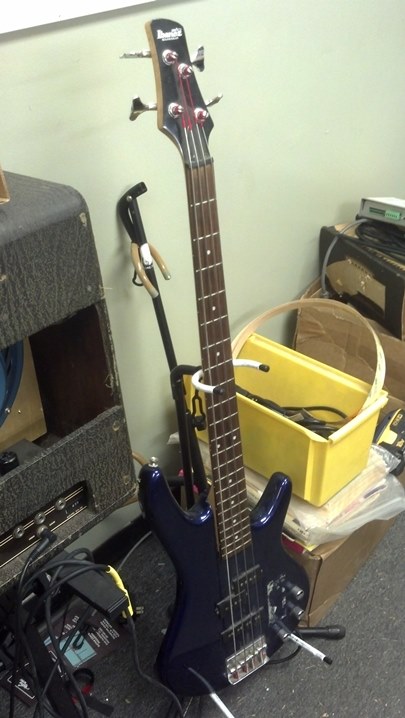
Because this will be a training tool and not a piece of performance art, the customer wanted the fret channels and position dots to remain visible.  Maple, a contrasting wood will fill the fret slots.  The maple veneer is coiled up in the yellow box next to the bass.
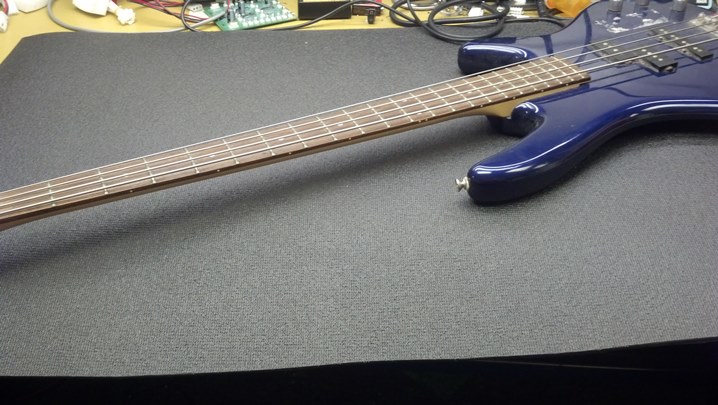
We’ll take one last look at the frets.  Say goodbye!
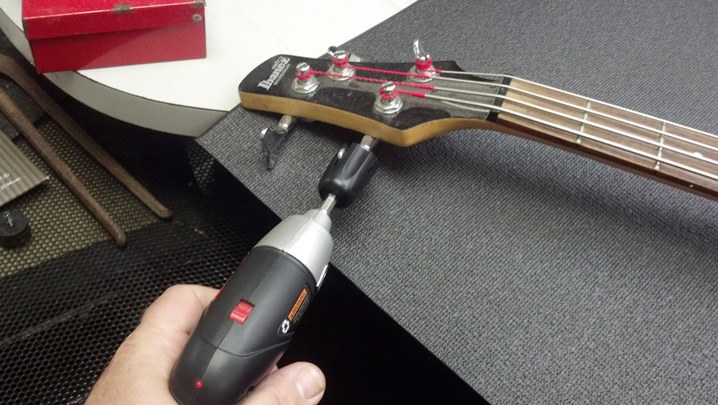
These strings are the original OEM Malaysian strings.  These are headed for the recycle bin.  The customer also asked that the headstock logo be removed, to add a little mystique.  The tuners will be removed and stored.
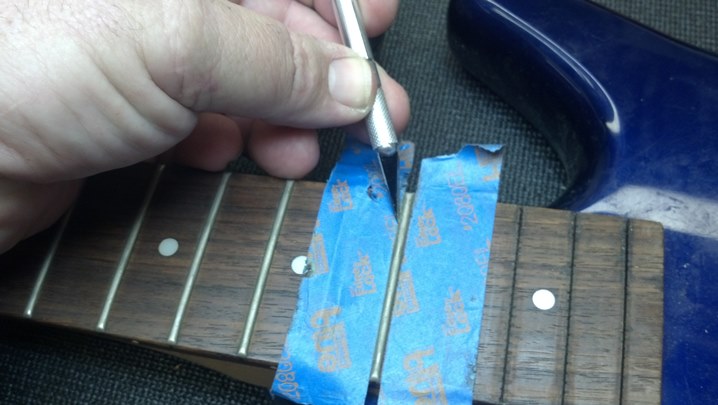
The tape protects the fret board from me.  An Exacto knife clears away the junk from the bottom of the fret to be removed so we can have something to grab.
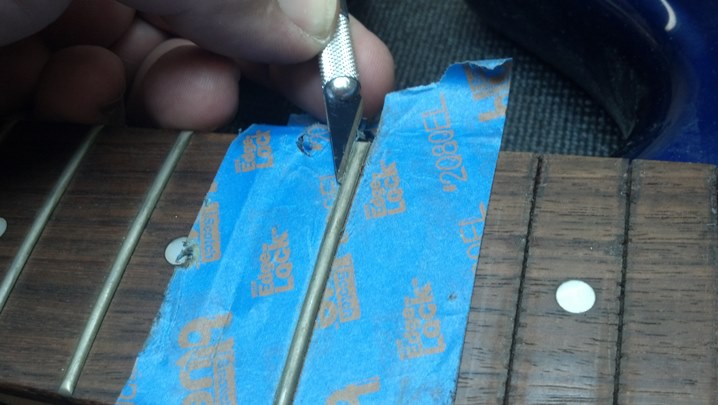
With a little care, the Exacto knife blade can be pushed under the fret wire to start the removal process.  Do Not Attempt This At Home, Kids!
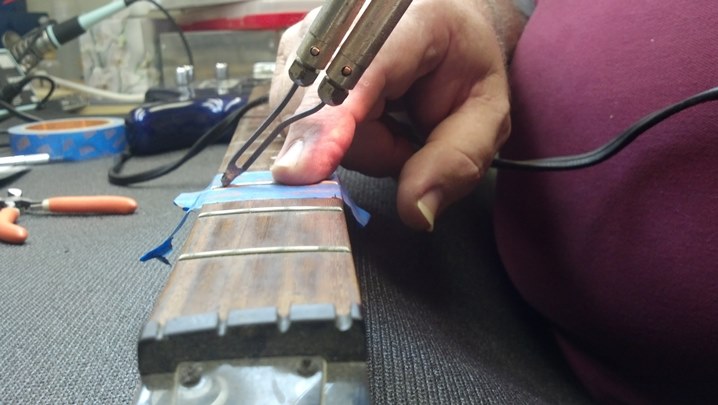
Each fret is heated with the soldering iron.
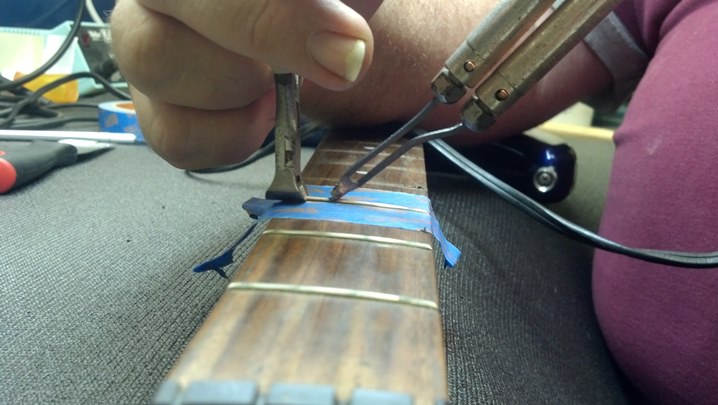
These Harbor Freight end-nippers have been ground flush and serve as a pretty good set of fret pullers.
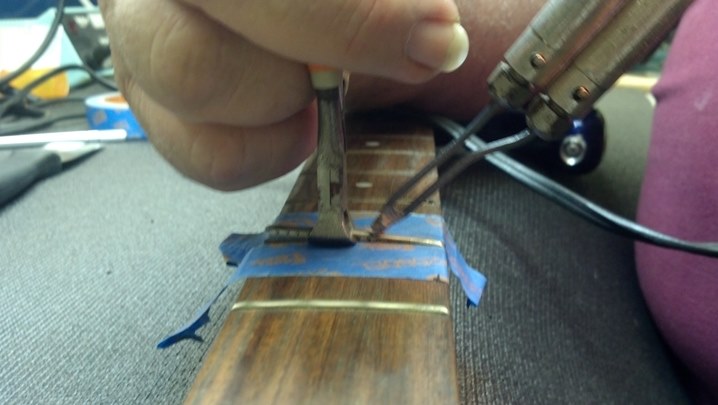
What the Exacto knife started, the fret puller finishes.
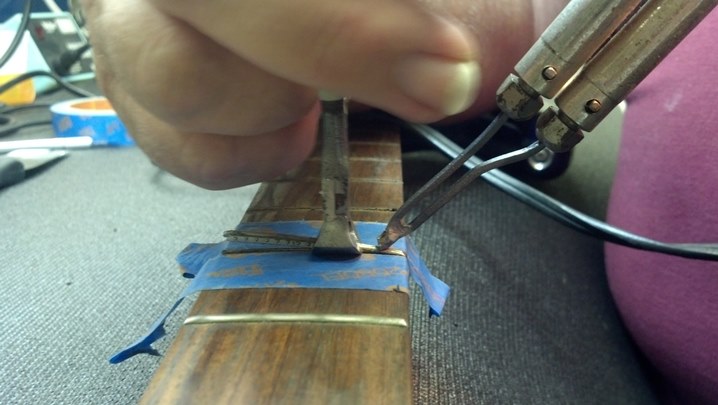
This takes a few moments so that I don’t tear out the wood around the fret tang.
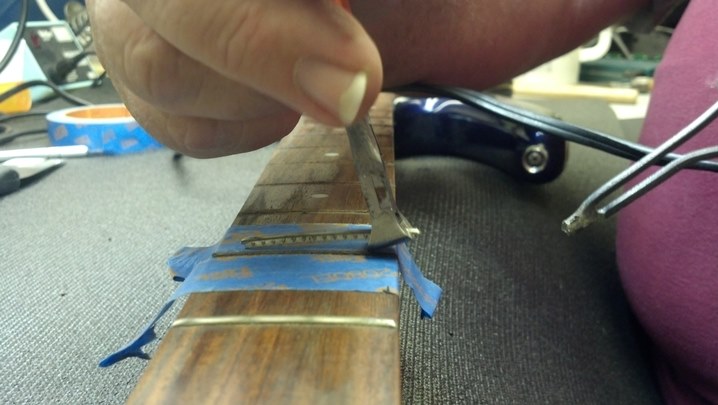
Houston, we are clear the tower.  Rinse, repeat.
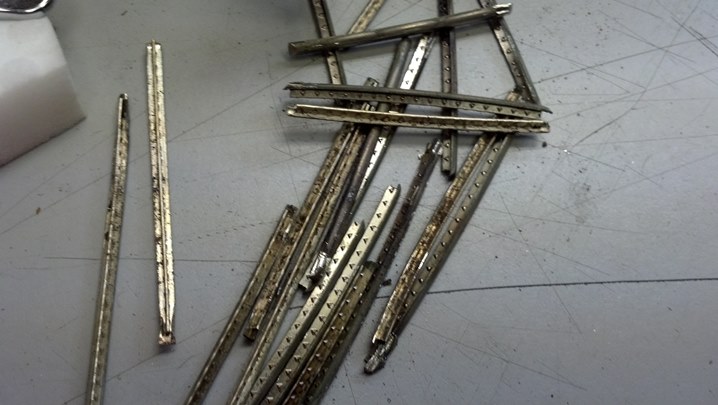
These are headed for the recycle bin, along with the strings.
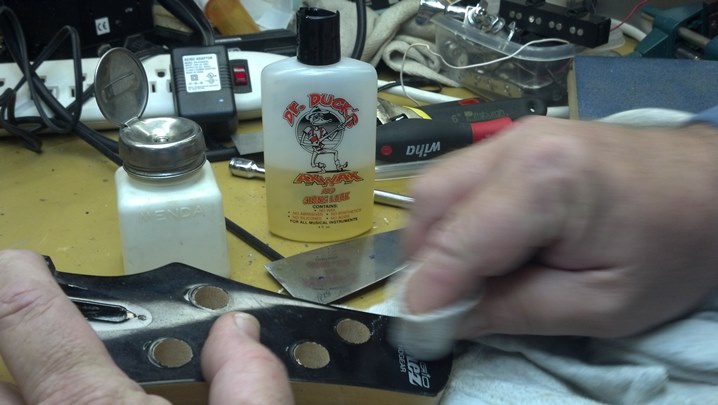
Some Dr. Ducks Ax Wax has just enough petroleum distillates to cut the headstock silkscreen.
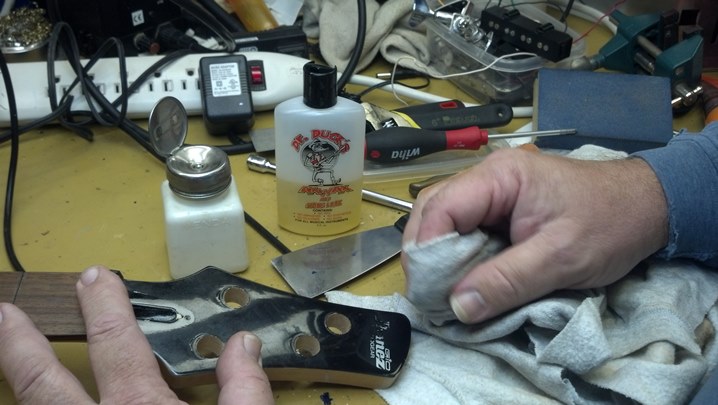
The head stock logo yields easily to a little Dr. Duck’s and a little Elbow Grease.

A tiny bit of compound restores the gloss in an even manner.  You can’t tell the silk screen was ever there.
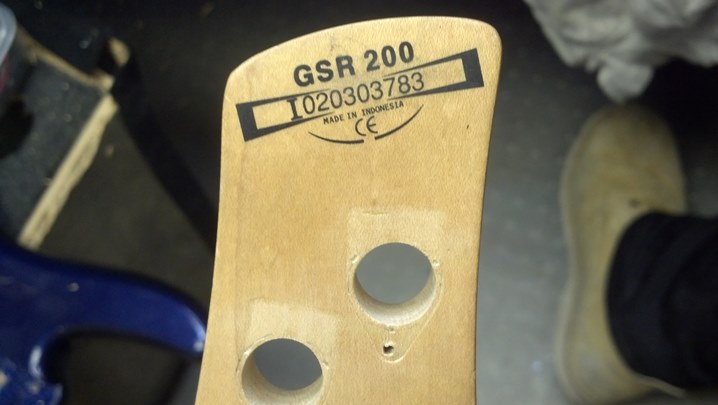
Say goodbye to the identification decal, too.  What the customer wants, the customer gets!

This was a decal, so it shattered into tiny fragments.  Be sure to remember this trick when you steal your next guitar.
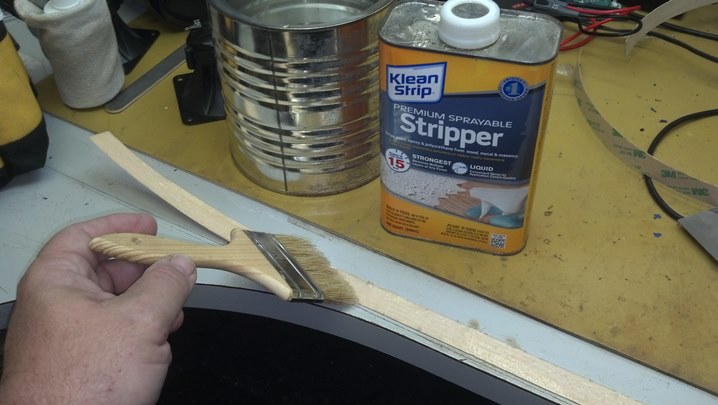
Now we move to the maple veneer.  The material we are using is sold as edging around laminate counter tops.  One face is covered with a thermally-sensitive glue.  This glue can be easily removed with some paint stripper.
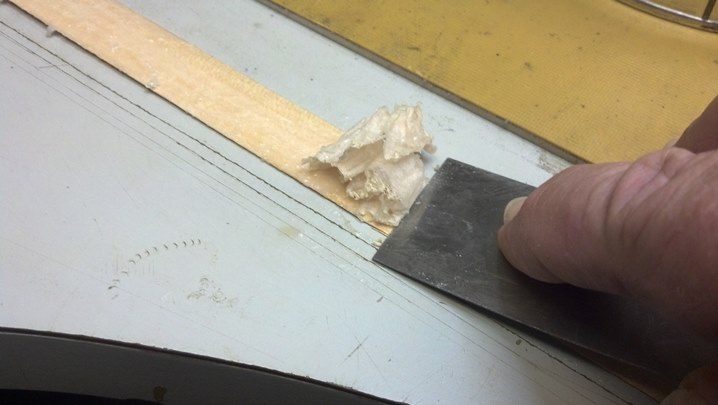
The stripper was brushed on, then scraped off.  This is kinda fun!
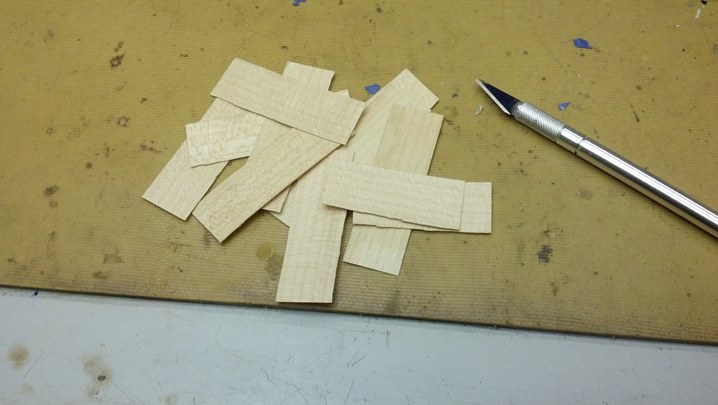
After the paint remover evaporates, we cut the veneer into two and a half inch long strips.
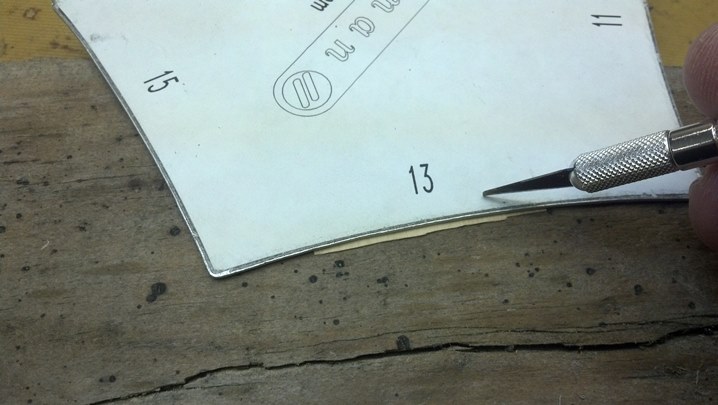
The bottom of the fret board slots are curved at the same radius as the fret board.  So I am using this home-made radius gauge as a cutting guide to radius the bottom edge of the maple veneer to match the bottom of the slot.
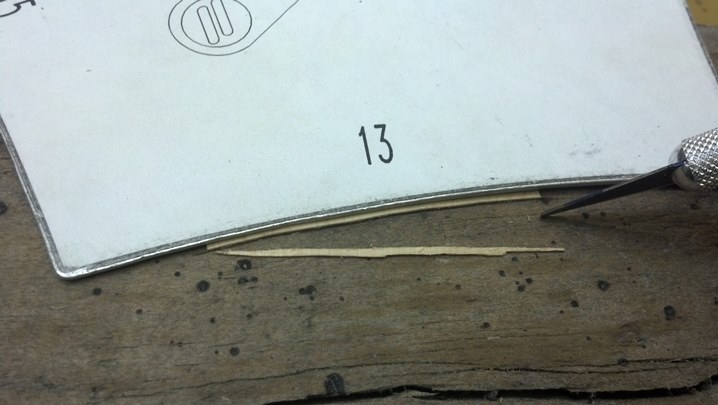
An Exacto knife makes short work of the veneer.  You sharp eyed visitors may note that the Ibanez bass fret board is 14 inch radius, not 13.  Leaving the center a little high allows a place for more glue.  This radius works perfectly.
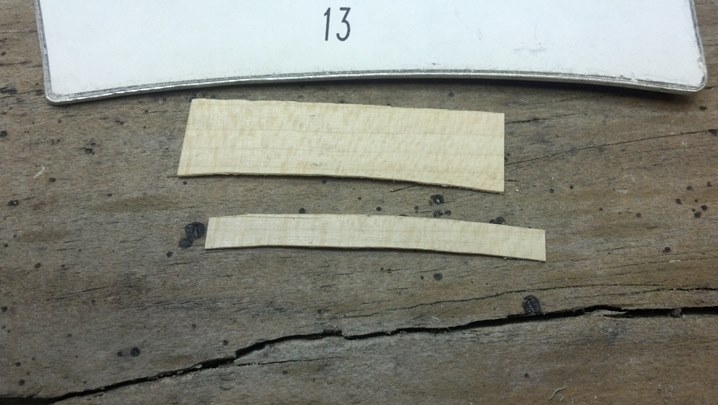
As one edge is cut, the veneer is slipped out from under the radius gauge, and another cut is made.
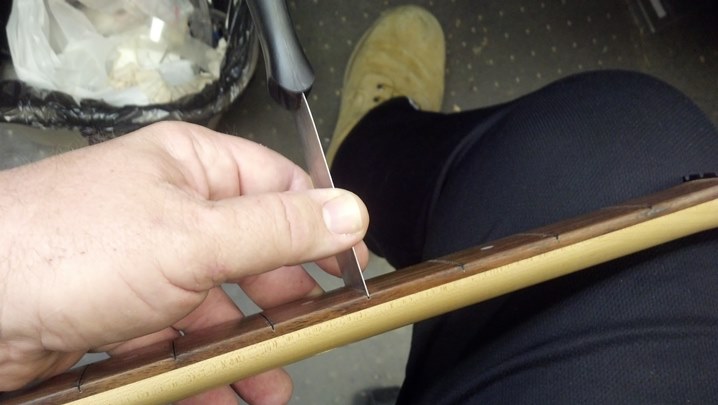
The fret slots need to be clean and straight.  Here, my scraper is just the right size to clear out the slot.
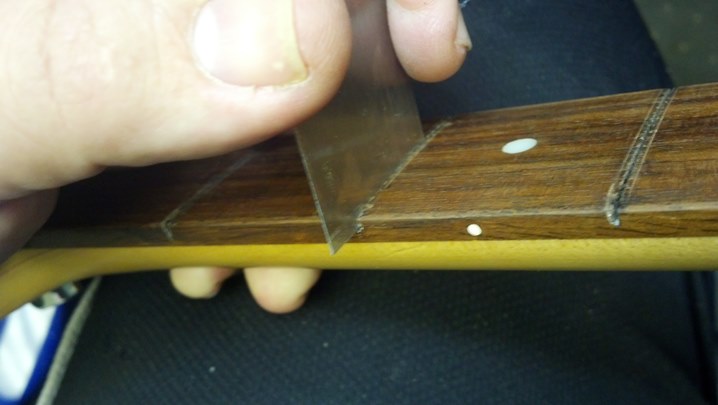
The ends of this scraper were ground square, creating a nice slot cleaner.
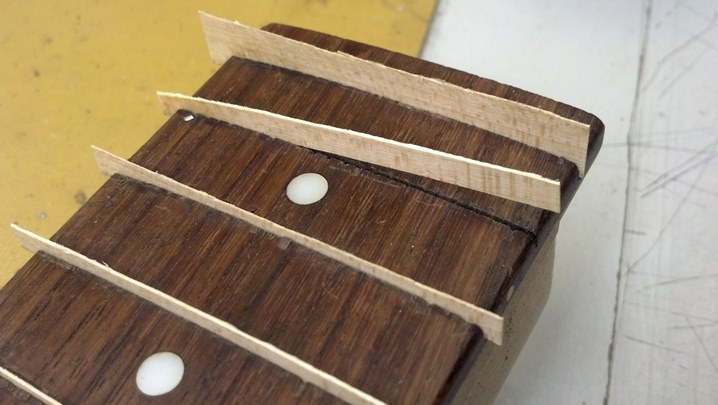
The radiused maple veneer pieces were glued into the slots using hide glue.
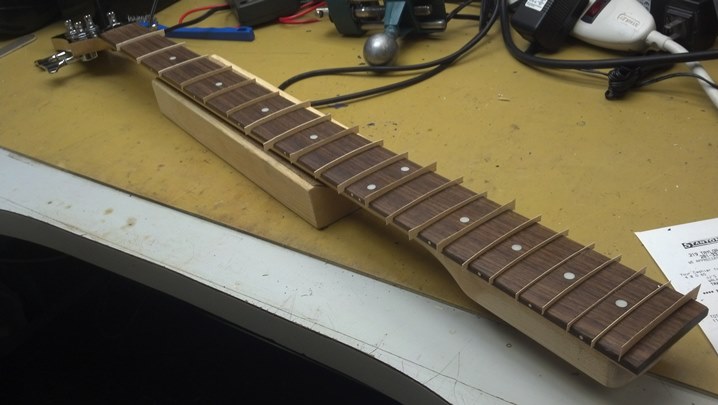
This looks like an oriental stringed instrument neck.
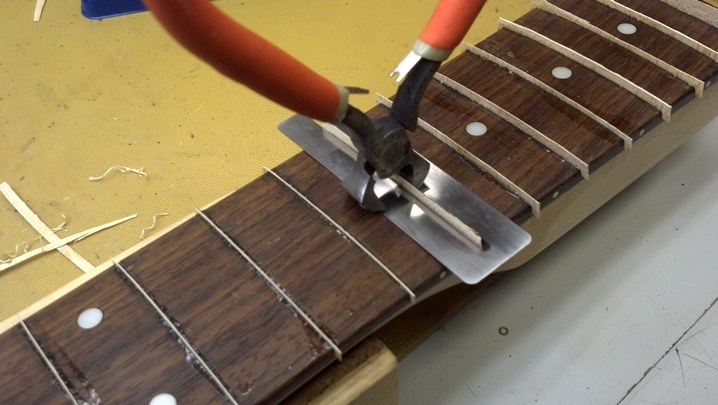
After the glue dried, I used the end nippers to do most of the coarse trimming.  A fret board protector acts as a shim to raise the cutting edges off the face of the fret board.
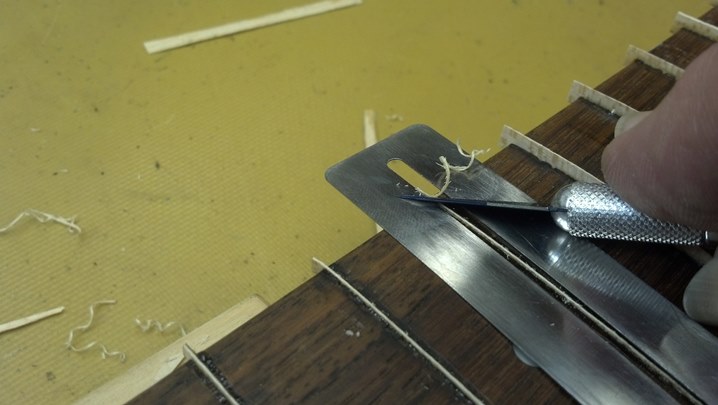
Next, I’m trying out the Exacto knife on the maple.  Nice curly shavings came off the maple filler.
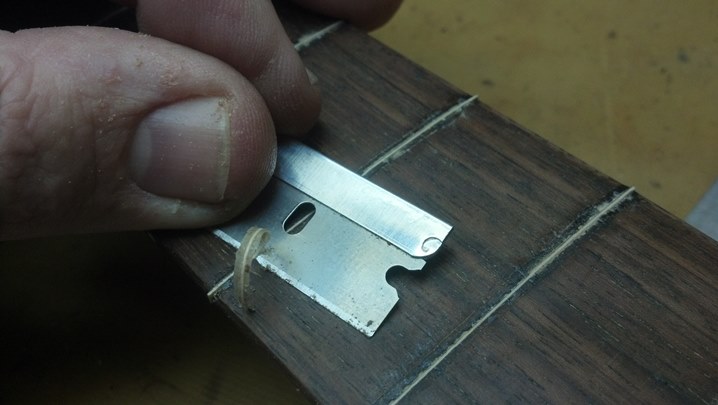
Working from the center of the fret board out, the single edged razor blade was perfect for the final smooth cut.  Note that a bit of the glue fillet is being removed here, resulting in a nice flat surface on the fret board.

Here is a closeup of the job the razor blade did on the fret board.  This will sand nicely.  A final check of the truss rod assures that the fret board is held absolutely straight, no relief or bow of any sort.
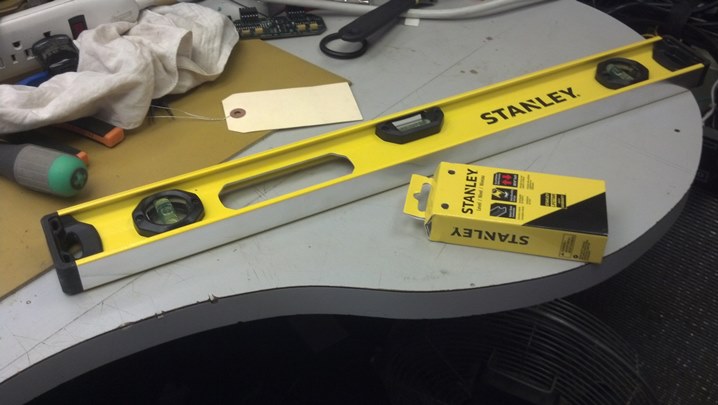
This Stanley spirit level has one edge machined to a very precise flat surface.
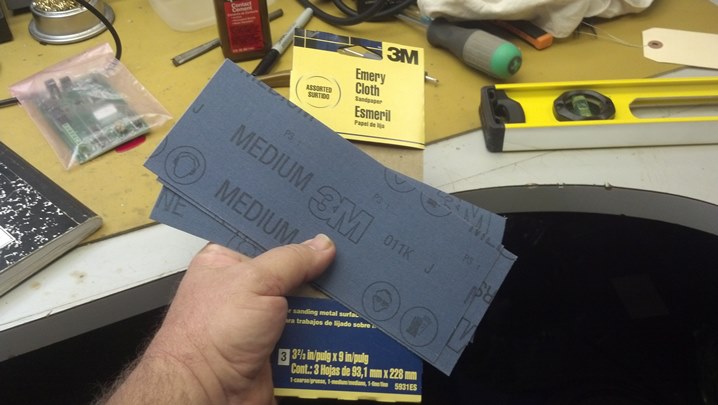
This emery cloth is a very aggressive and durable abrasive medium.

A sheet of emery cloth was cut to fit the machined edge of the spirit level.  Now we’re ready to build our own sanding beam.

The emery cloth will take at least two coats of contact cement because the first coat soaks into the cloth.
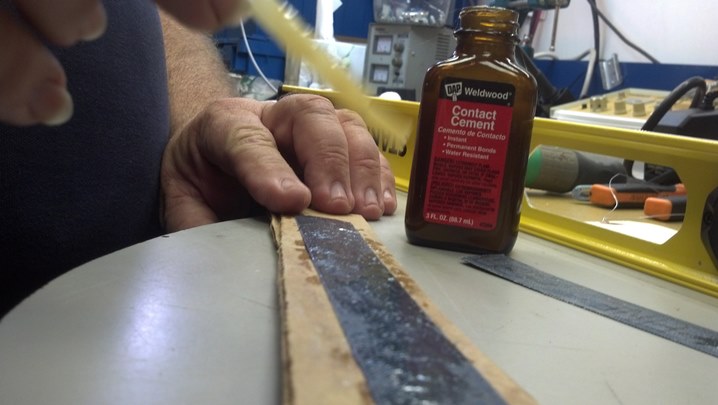
In case you missed the first one, here is the second coat of contact adhesive

The strips of emery cloth form a continuous abrasive surface along the entire length of the spirit level.
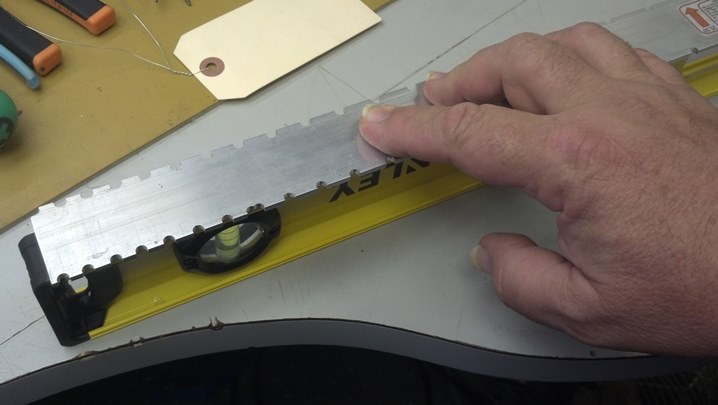
This heavy aluminum fret board gauge is just right to mash out all the air underneath the emery cloth.

The spirit level makes a sanding beam that is the perfect length for this bass fret board.  See the dust at the right end?

Now that the fret board is straight, we will reestablish the radius of the fret board with this 14 inch radius sanding block.

Radiused and straightened, we’re ready to apply a hard finish to the fret board.  Everything that is not fret board is covered with tape.  If you hadn’t noticed, the nut was removed prior to sanding.
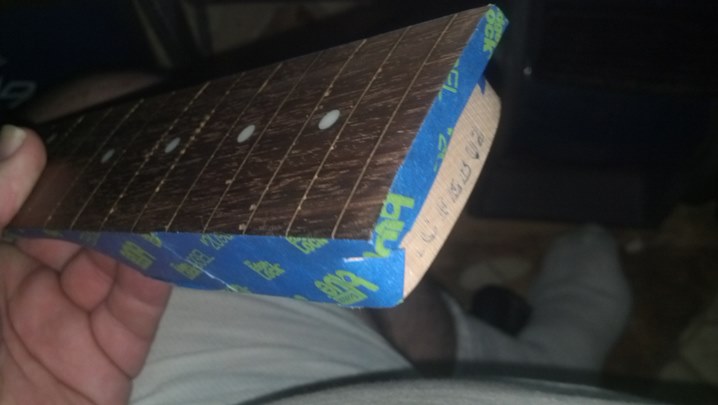
I didn’t want to put much finish on the end grain at either end of the fret board in order to minimize any swelling or expansion that would spoil the shape of the fret board.  When the wood is sealed, I’ll go back and finish the end grain.
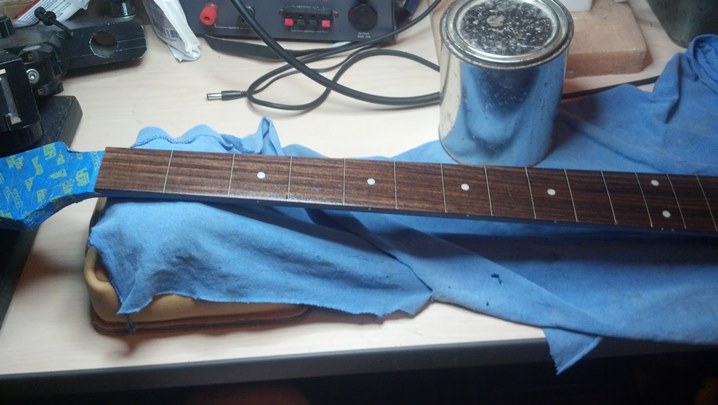
The unlabelled can contains Diamond Varathane Floor Finish, a commercial polyurethane finish used in roller rinks and bowling alleys.  I discovered this stuff when finishing pine furniture.  The Diamond Varathane was the only thing that would stand up to my cat’s desire to chew on the corners of the furniture.  Absolutely bullet-proof.
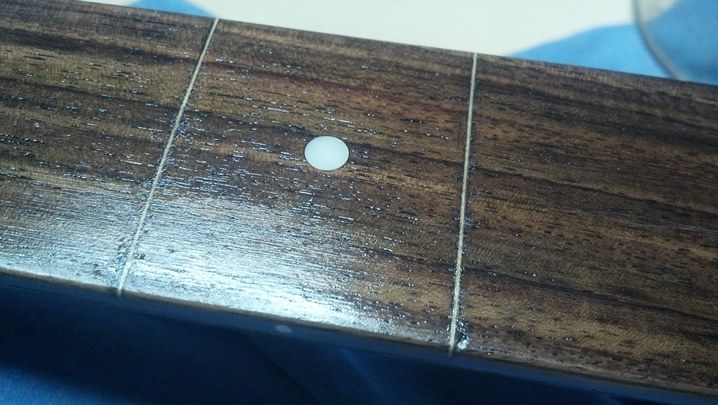
The first ten (yes, that’s TEN) coats were applied with a brush.  We are filling a lot of wood pores, you know.
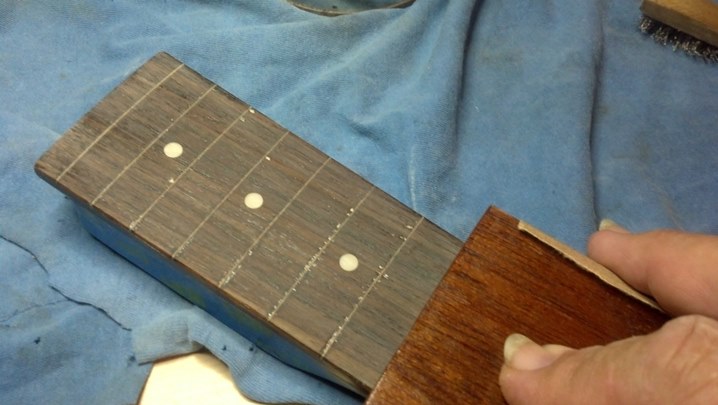
The radiused sanding block gets quite a workout, starting with 80 grit, then moving finer.  This is 220 grit.  The tiny dimples around the fret slots are filling in with each coat of Diamond Varathane.  Ten coats were applied and sanded to radius over a period of nineteen days.
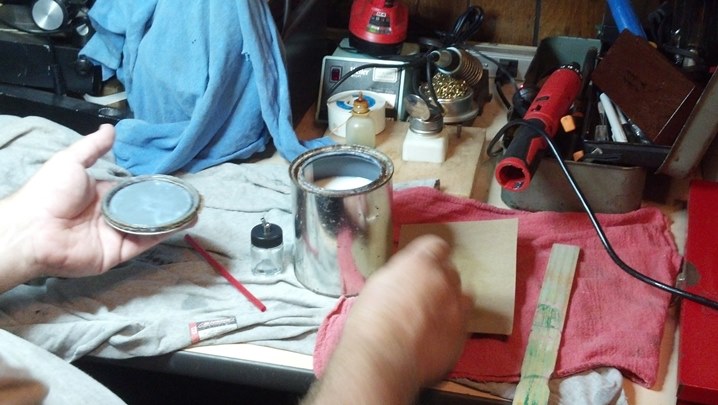
For the final finish process, the next five coats of Diamond Varathane are applied with an airbrush.  Here, the Diamond Varathane is thinned slightly with distilled water.
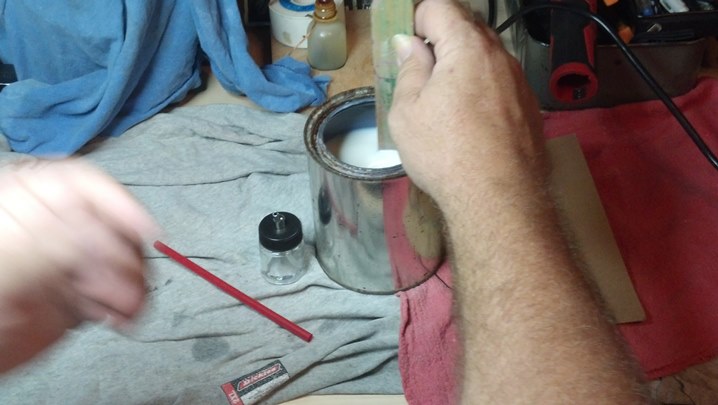
Thanks to my Darling Bride, this stirring moment in history will be preserved forever.
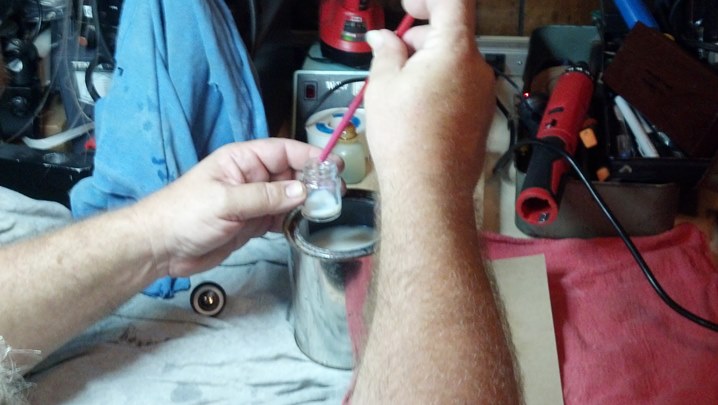
A plastic soda straw makes a nice disposable pipette to transfer the finish to the airbrush reservoir.
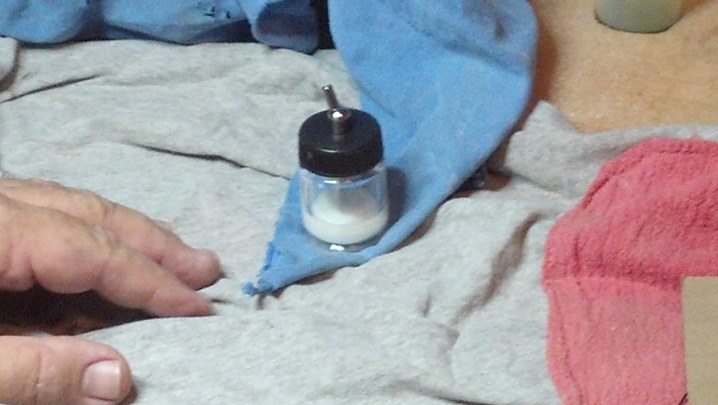
We’re loaded.  Not much finish is needed for the final coats.

Everything is assembled.  This little air brush comes from Harbor Freight, and is surprisingly good quality for cheap ChiCom junk usually found there.  The air and the flow of material is easily controlled on the fly, while you spray.
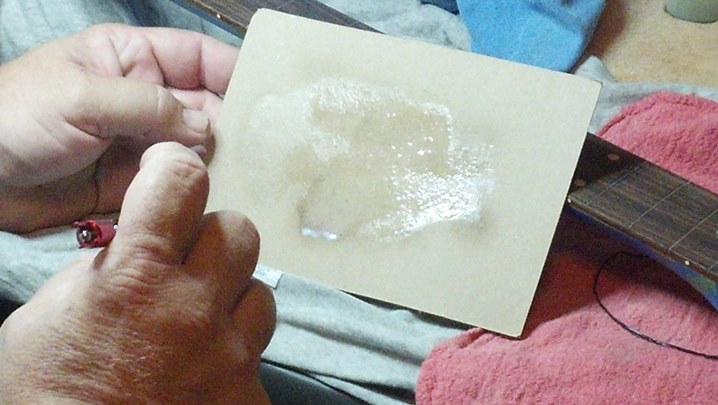
We are experiencing technical difficulties.  One moment, please, while we display a Test Pattern.
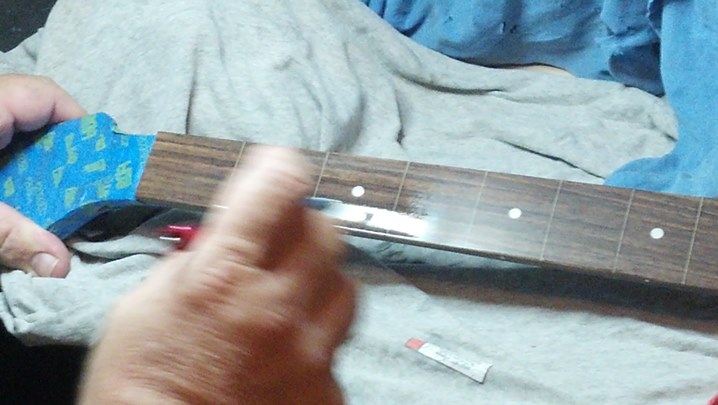
The sprayed finish goes on much more smoothly than a brushed coat, which is why I switched to the airbrush for the last five coats.
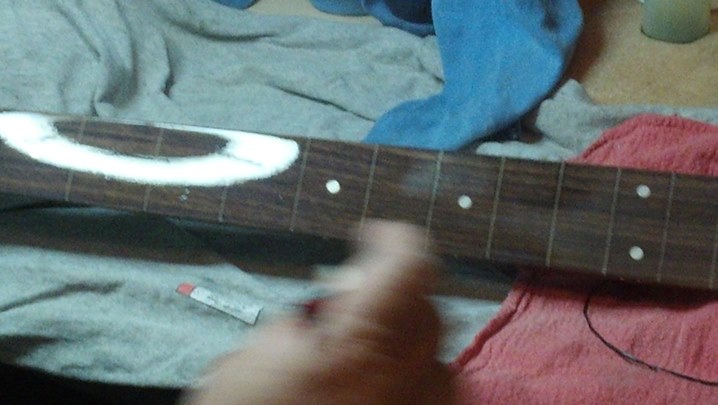
Now this is beginning to look like a fine musical instrument!
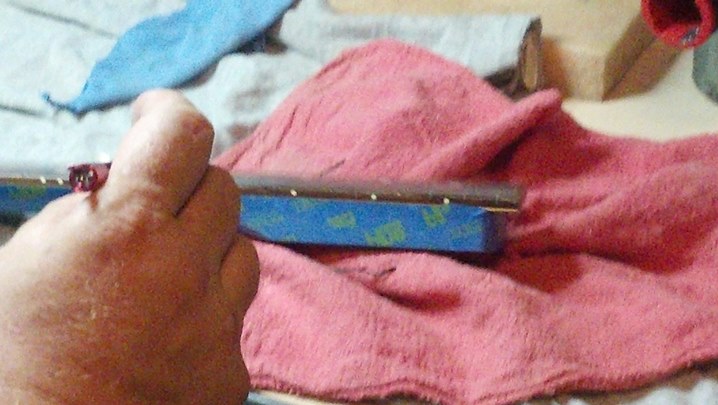
The exposed edges of the maple fret veneer is sealed with some Diamond Varathane as well.
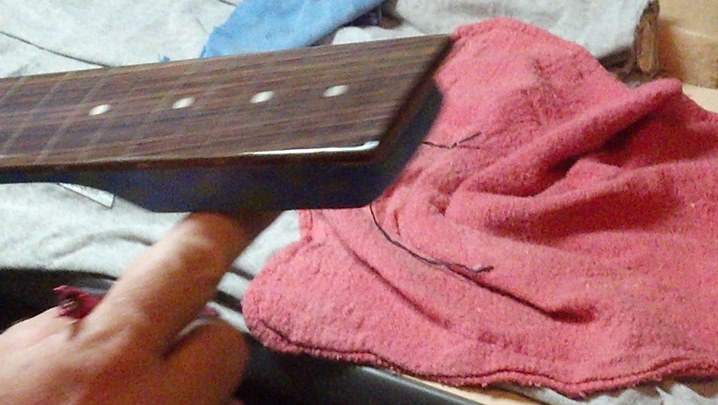
For the last two coats, I also sealed the end grain of the fret board.
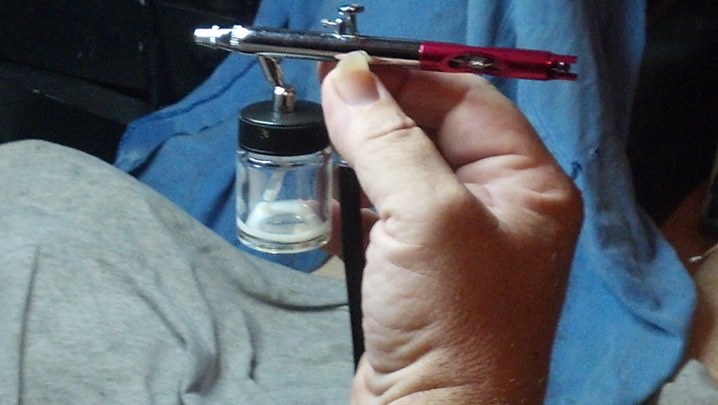
One coat on the fret board does not require much finish.
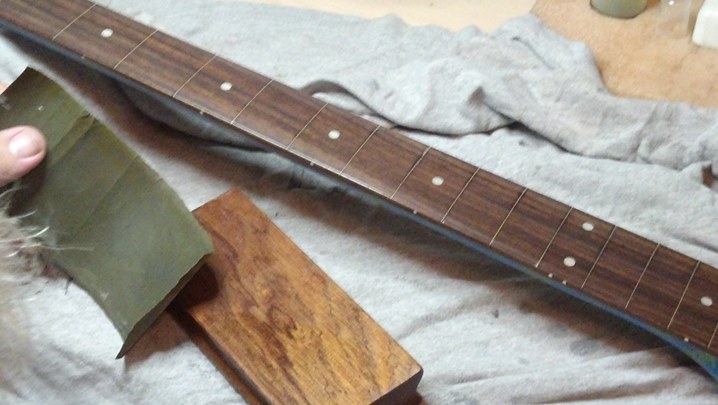
The last five coats were wet sanded.  Three coats were radius sanded with 400 grit paper, the last two with 1000 grit.
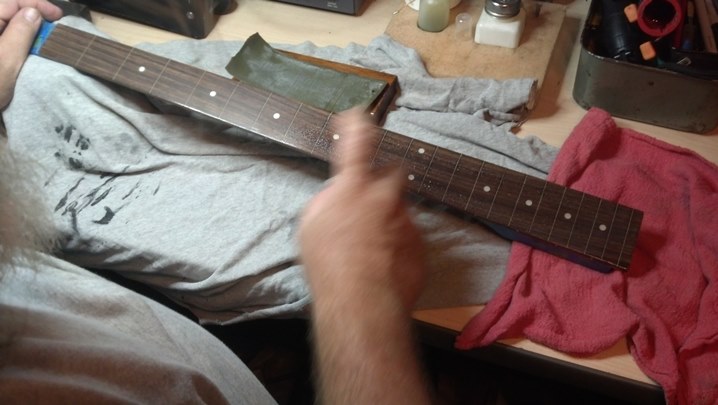
A little rain water was spritzed on the work piece.
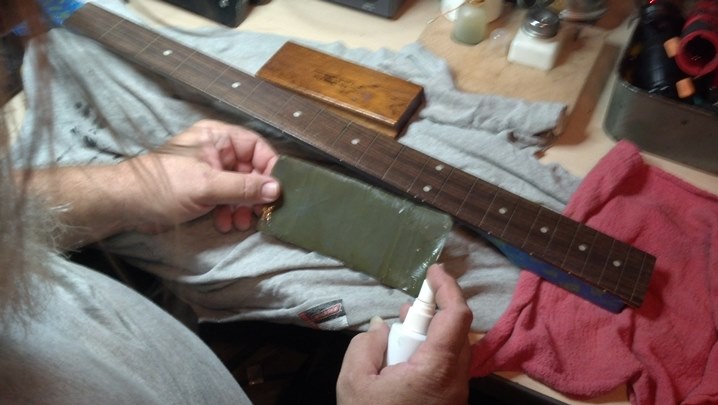
Keeping the sandpaper wet is a good way to keep material from building up and clogging the sandpaper.
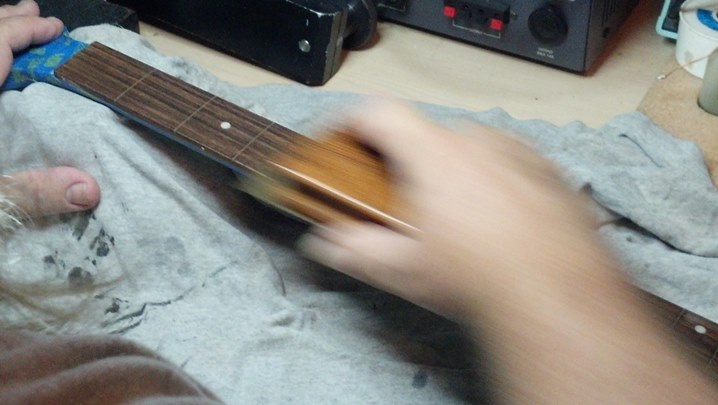
Wet Sanding At It’s Finest!

Tiny bits of the Diamond Varathane are floated away in the wet sanding process.
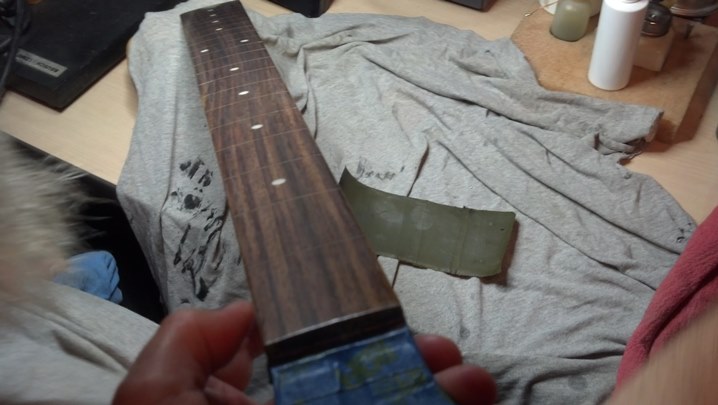
Thus begins the final sanding session, 1000 grit wet.  Very little material is actually removed.  This is just surface prep.
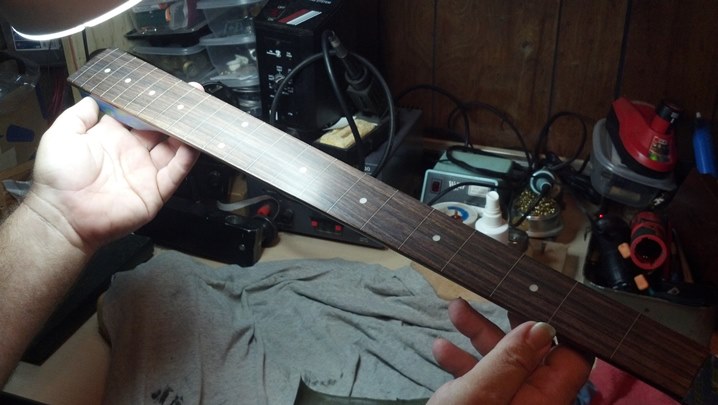
Here is the fret board after the final sanding and dry-off.
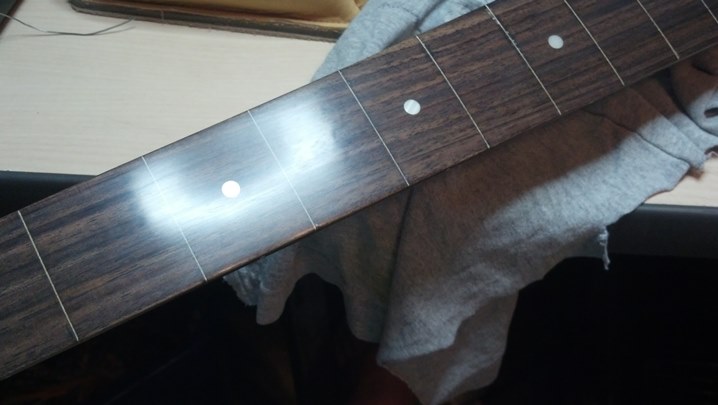
This is fifteen coats of Diamond Varathane, rubbed with a cotton cloth to bring out the shine.

Here is a nicer view of the hand-rubbed finish, with reflections courtesy of Mr. Brewster Angle.

Off comes the tape.  A tiny bit of wet sanding and rubbing is used to smooth the edge of the finish so that it blends into the original finish on the back of the neck.
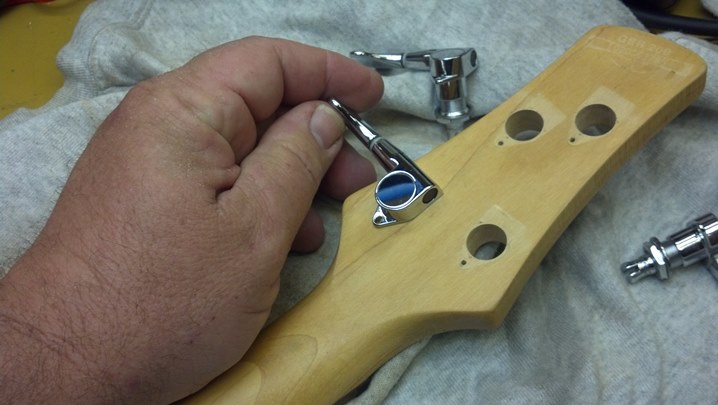
Time for tuners!
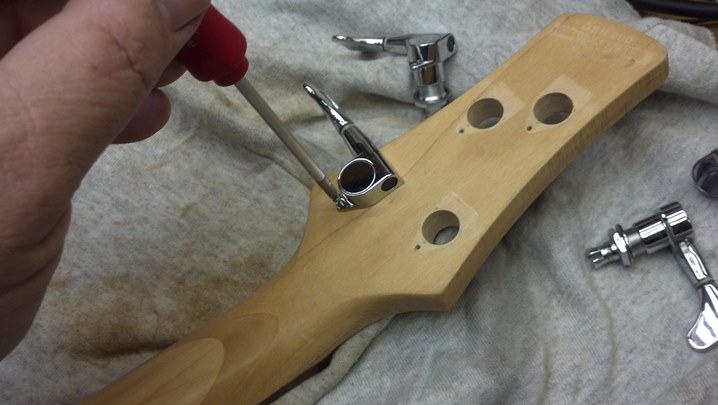
Some folks can artificially age guitars with ultraviolet light to remove these ‘tan lines’ but I don’t do that.
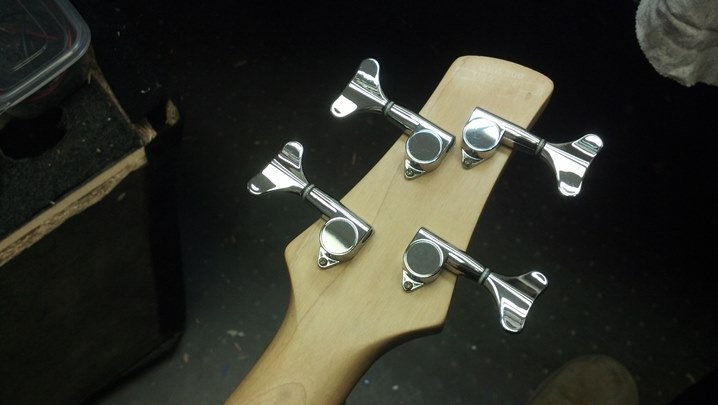
Warning – Guitar Porn.
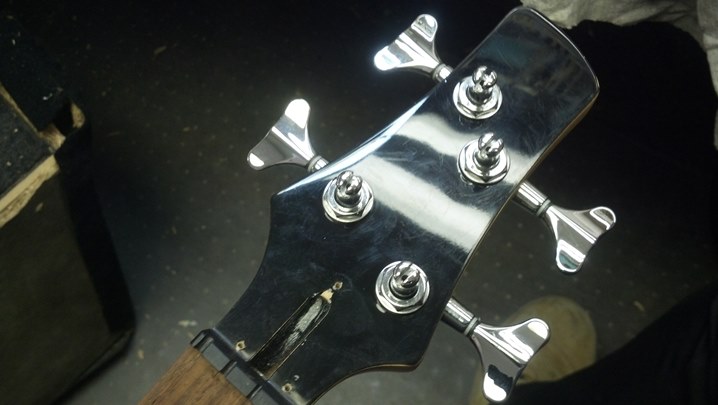
Oops, I need to remove some fingerprints on this side.  The nut is glued back on and we’re ready to reattach the neck to the body.

The action is, of course, WAY too high now that the frets are gone.
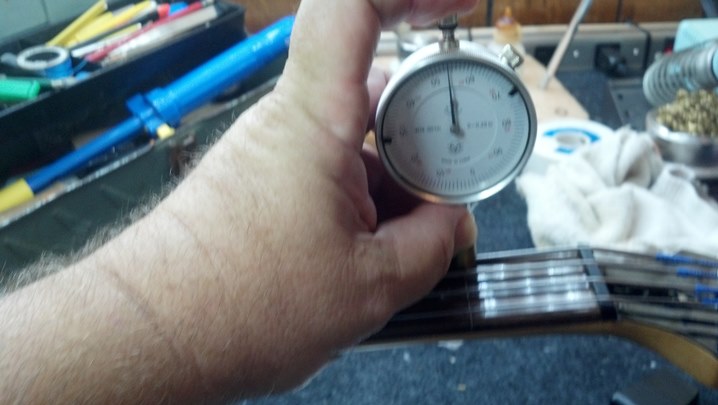
These strings are about 0.056 inch off the fret board at fret one.
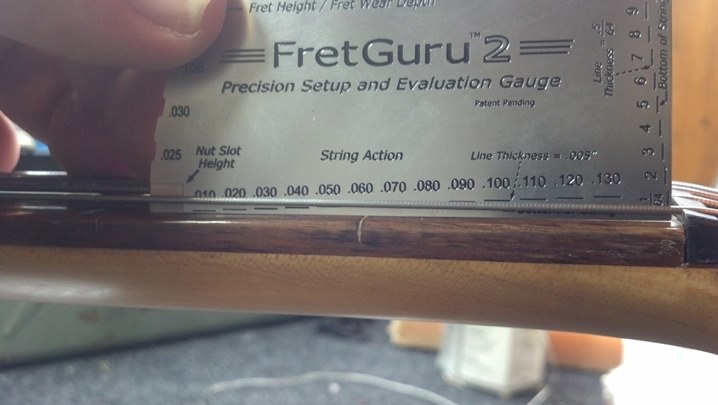
As a sanity check, this gauge shows the same measurement.  This is a nice closeup of the finish on the neck.  The Diamond Varathane is absolutely rock-hard after curing.
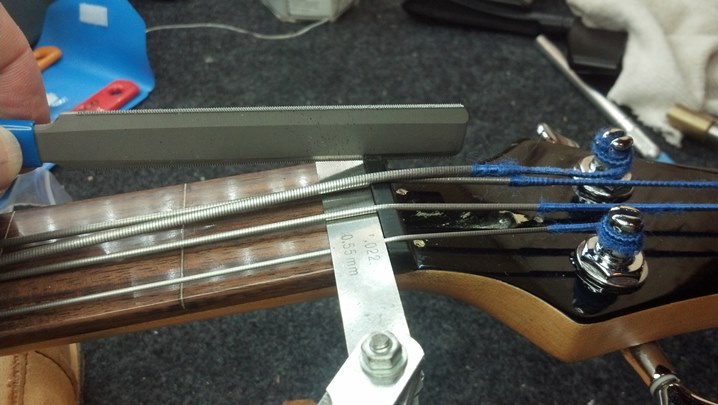
I put this 0.022 inch feeler gauge under the string slots, then proceeded to deepen the slots to just touch the gauge.
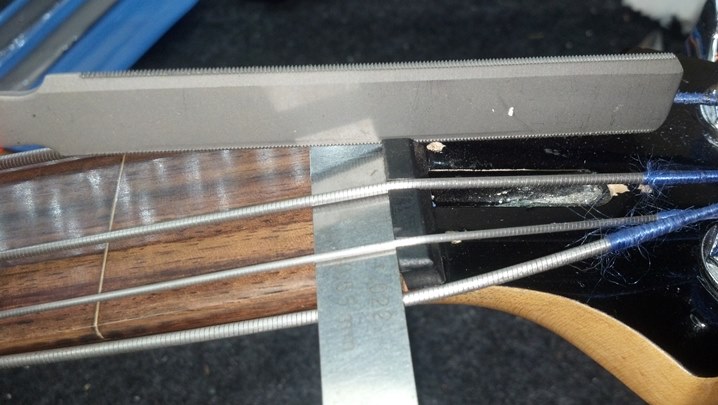
Here is the A string file at work.
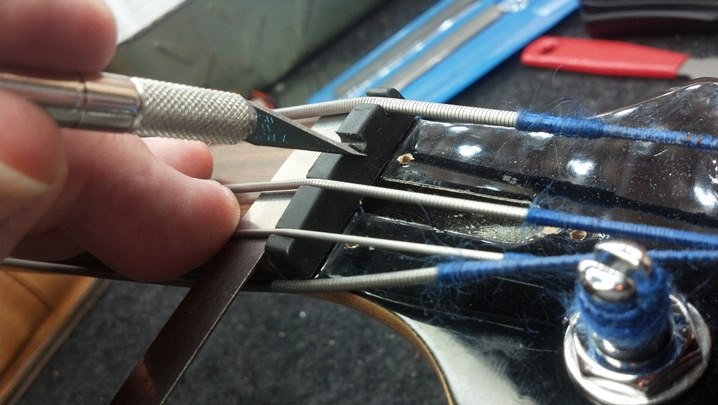
The plastic nut flows a bit when worked.  An Exacto knife trims away the flash.
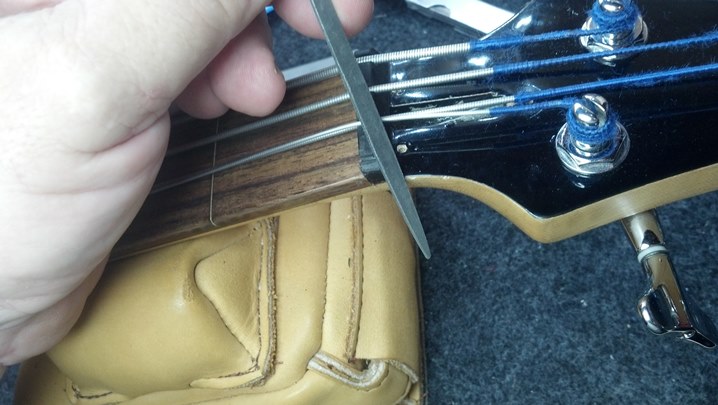
Time to take any sharp edges off the nut.  Playing a fretless bass is all about the “feel,” after all.  After a neck shim and a simple setup at the bridge, this bass is ready to mwah.


Thanks for reading all the way to the end of this long post!

CONTACT – David Latchaw  EE

281-636-8626
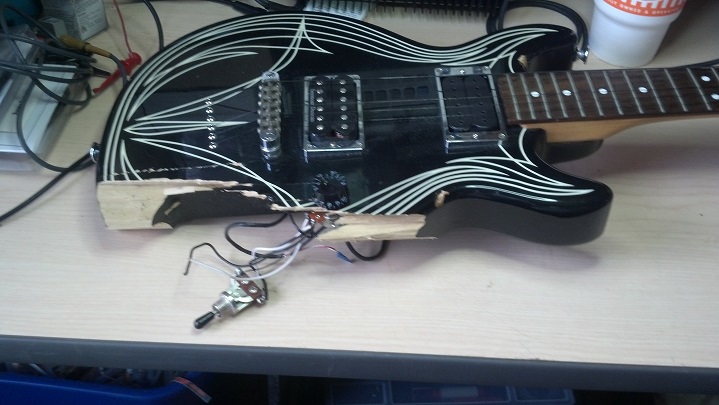
Ex-GF Smashes Jackson Guitar

Can’t live with them, can’t live without them. A late-night call was the starting point of the end of a relationship between a young man and his guitar. His prized Jackson was smashed by a cray-cray now-ex-girlfriend, and his new squeeze sported dull, boring factory pickups. Could the Unbrokenstring Crew salvage anything from what had been broken, and spice-up the rebound relationship?

Here is most of what was left of the Jackson.  These pickups sounded pretty cool with his rig, so he wanted a pup transplant.  Beyond the bridge, strap buttons, switches, and maybe the neck, this guitar was now firewood.

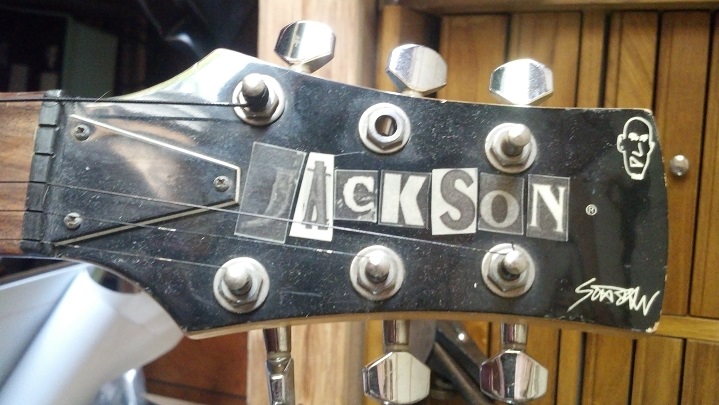
I’m not into Jackson guitars, but that is some unusual artwork.  Maybe a fake?

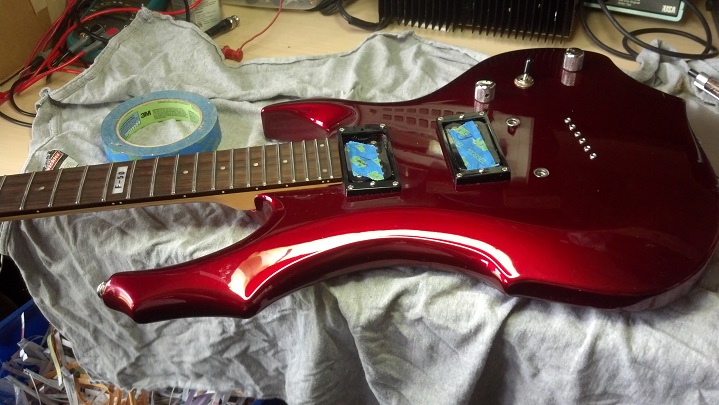
Now this is a purty guitar!  Hope his new girlfriend isn’t the jealous type.

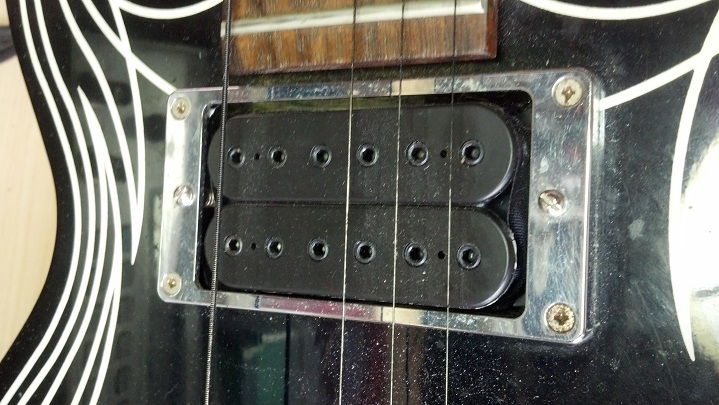
The neck pickup of the Jackson is a DiMarzio Evolution.  It measures about 13k ohms.

Yep, it’s an Evolution.  Steve Vai, anyone?

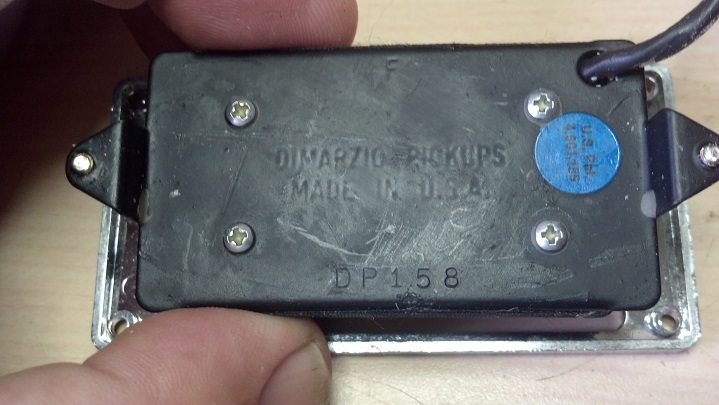
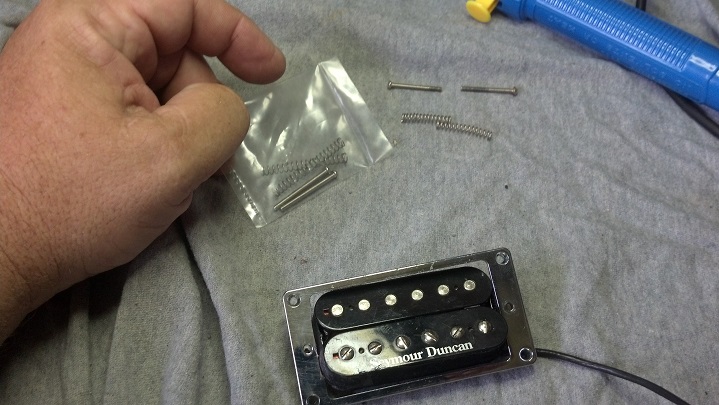
I’ll give you three guesses who made this Custom Custom pickup.  However, it is a tight fit for that trim ring because the trim ring is pulling the tape off the windings.  I can fix that.

The coils read 14.4k ohms, which tells me these are OK despite the rubbing damage.  Lidia Daniels wound this pickup!

This selector switch is OK but not needed today.  I’ll clean it up and return it to the customer.  What a hack job!

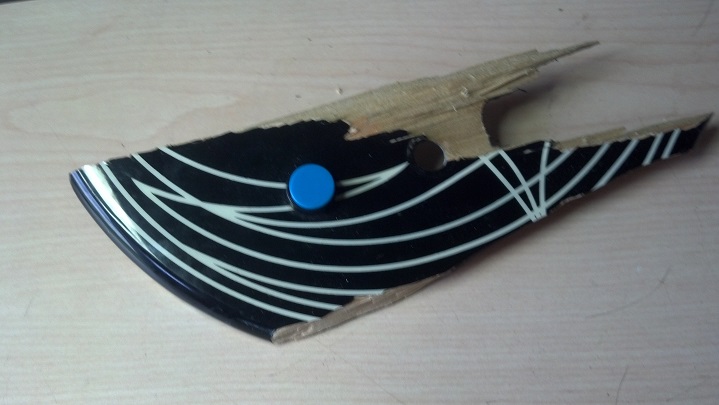
One of the broken pieces has this cut-out switch.  I’m not going to route the new guitar to add this button today.

We’ll clean this up too and return it to the customer.  The blue button would look ‘cheap’ on the deep red guitar.

The cadaver is ready for the body bag.  The police can clean up the crime scene.  Our job here is done.

The bridge pickup trim ring was scraping against the insulation on the windings.  A Dremel tool with a sanding drum created some space in order to set the pickup height properly.

However, the pickup height could not be set because a screw and a spring was missing.  I just happen to have here, in my formerly-nicotine-stained fingers, some left-over hardware from another pickup installation.

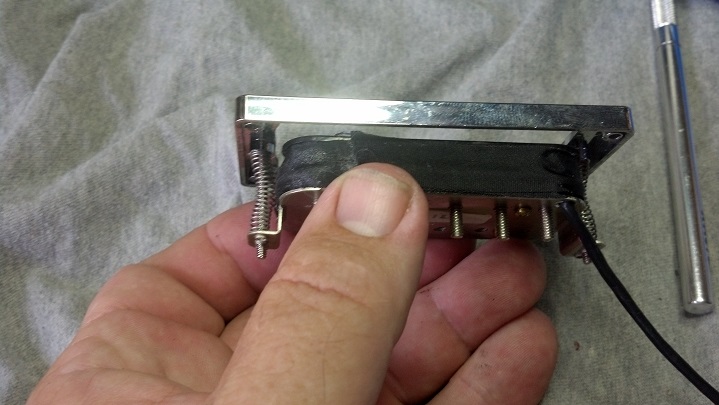
From this angle, you can see the bump in the pickup windings, and the clearance for the bump carved into the ring.

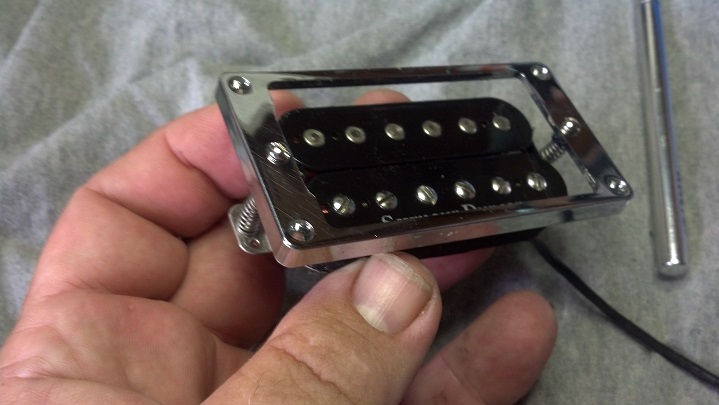
Yeah, that’s better.  Not too shabby-looking, either, after a quick buff and polish.

The factory pickups in this LTD F50 work fine, and will be removed and returned to the customer.  I have marked them N for neck and B for bridge.

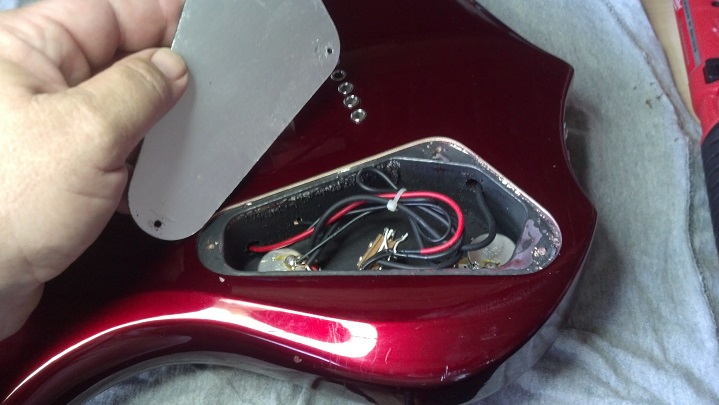
We’re going in!  Everything here seems to be in order.  The pickup wiring goes straight to the selector switch.  Easy!

This is the DiMarzio in its new home.

All the wiring is pulled through the routes in the body.  The guitar is starting to look snazzy!

This does not look a whole lot different than it did before I started.

Pimp My Ride!  Y’all have seen new strings and a setup before, so we’re done with this blog.  One relationship ended, and another one begun.  BTW this guitar sounded FANTASTIC in the hands of the owner!


Thanks for reading all the way to the bottom!

Contact:  David Latchaw  EE

281-636-8626

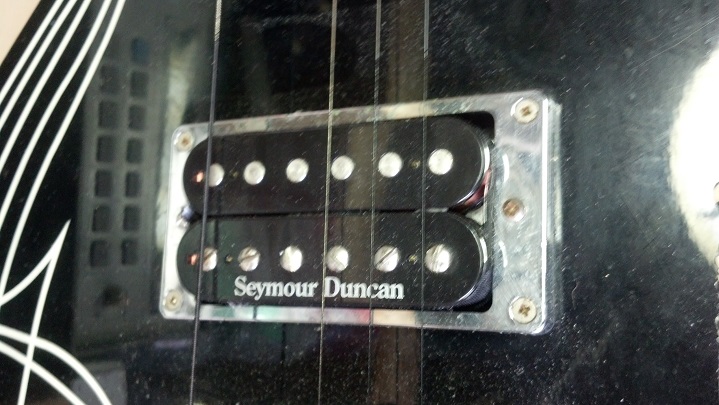
New Seymour Duncan Pickups for an ESP LTD

Experimenting with various pieces of gear is one aspect of the guitar hobby that appeals to most players.  This Indonesian-built ESP would benefit from some after-market modifications.  Here We Go!

This is not a bad guitar, and is surprisingly easy to play despite it’s flying-Vee shape.

What the customer wants, the customer gets!  These will fit right in to the guitar without any modification.

As you can see, this guitar is strung through the body.  If you look closely, you can see that the string saddles are all going the same direction.  From a practical point of view, this doesn’t make much difference as long as the intonation can be set properly, but many an Internet flame war has been waged over the ‘correct’ saddle orientation.  Spare me.

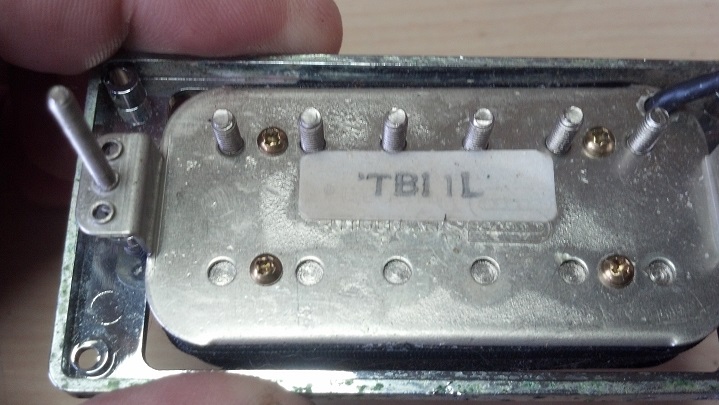
These are the original factory pickups.  They work fine, and will be saved and returned to the customer.

The main work will happen underneath this cover.  All of the wiring is terminated here.

The original electronics are just fine.  I’ll cut the tie-wrap and sort out where the existing pickups are wired.

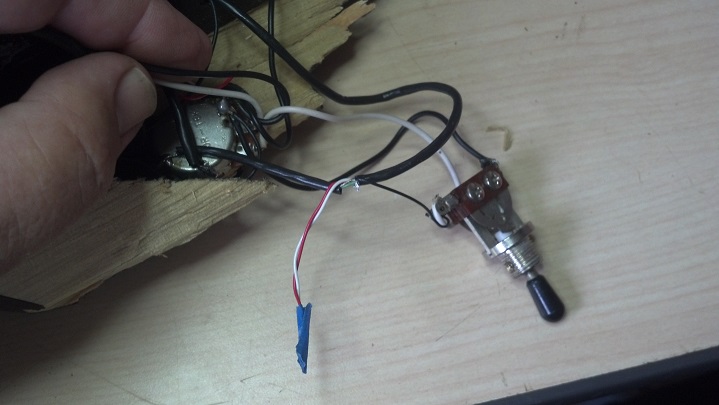
Both pickups are wired directly to the selector switch.  The red cable is the neck pickup.

Note that the trim screws are different length.  Knowing which screw goes where will be important when putting everything back together.

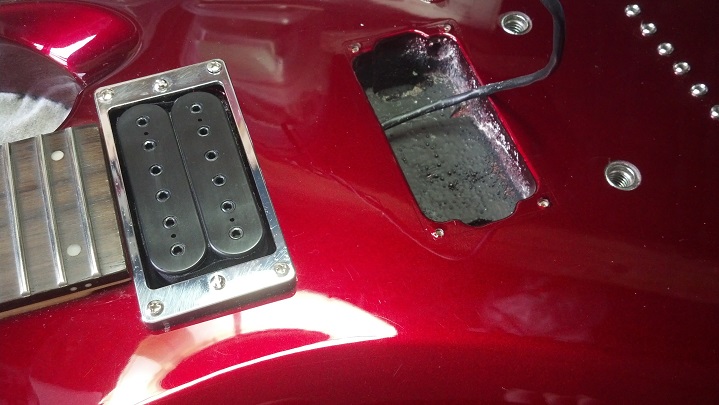
We are liberating the the neck pickup and trim ring.  Note the red insulation.

The cable to the bridge pickup is covered in black insulation.  Note the common passage that both cables use on their journey to the wiring cavity, accessible from the back.

Houston, we are clear the launch tower.

The original pickups were stored in the same container in which the new pickups were delivered.  And, because I’m forgetful, I made a note about which one was which.

I clipped the wires in order to remove the old pickups.  The solder sucker is clearing away the terminal where the neck pickup was wired.

Now we’re cleaning up where the new bridge pickup will be soldered.

All the shields were wired together and attached to the body of the selector switch.  Here, I’m cleaning this up so that a new solder connection to the shielding braid can be made.

With all the hardware off, this might be a real good time to clean everything up, don’t you think?

That’s better!  Oops, I did it again…  Guitar Porn!

The Seymour Duncan pickups were wired for split coil operation, but we’re not using that option today.  Thus, the two halves are soldered together, as shown here.

Heat shrinkable tubing insulates and protects the splice.

The original pickup trim rings are cleaned up and polished.

Can you guess which one is the neck pickup trim ring and which one is the bridge pickup trim ring?

With a little patience, the new pickups are integrated into the trim rings using the springs and screws provided.

Here, I’ve snaked the neck pickup cable through the body of the guitar.

And as we saw earlier, the cable passes through the bridge pickup route and onward into the electronics cavity.

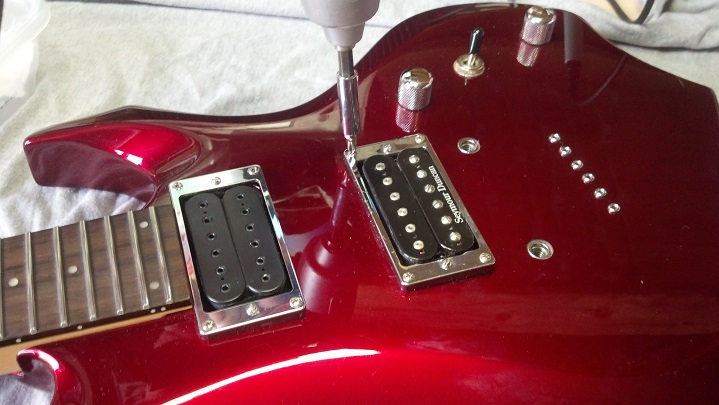
I’ll use a couple of the trim ring screws to temporarily keep things in place.

Same with the bridge pickup.

The new cables were soldered where the old pickup cables were originally installed, and a fresh tie-wrap will keep things under control.  We’re done here.

Now that the guitar is closed up, it’s time for a little Fret Love.

We’re all set up and ready to play!

Jacob does a final test on the electronics and guitar action.  He was pleasantly surprised that such a radical-looking guitar could be so easy and fun to play!  Good Job, Unbroken String Crew!


Thanks for reading all the way to the bottom.  More Guitar Porn to come!

David Latchaw  EE

281-636-8626

First Act “Discovery” Kid’s Guitar from WallyWorld, Back From The Trash

This toy guitar has a built-in amplifier and speaker.  Although not a ‘serious’ instrument, I readily agreed to check this little guitar out for a friend.  Yes, they literally found it in the trash.

Now, before you Gear Snobs click your tongue at anyone who would be interested in spending any time with this guitar, there are tens of thousands of three-quarter and seven-eights scale guitars sold each year, and a few hundred half-scale guitars.  The youth market requires down-sized guitars for little people who don’t have the arm strength or finger length to support a full-sized guitar.

The only concern I had was, could the guitar be playable, have good intonation, and could it make music in such a way that would not discourage a potential future musician?  Undeterred by your definition of “making music,” the Unbroken String Crew jumps to work!

So the mushroom-shaped plastic covers keep the sharp string ends from harming the little kiddies.  The string tree is cool.  The deep slots in the plastic nut are pretty standard for cheap Chinese guitars.  What is wrong with those people, anyway?

I’m a little surprised that these open-gear tuners would ‘fly’ past the product safety people.  Isn’t this a pinch hazard?

The battery under this cover runs a built-in amplifier.  No buckle rash here (or maybe I should say, no safety pin rash.)

The amplifier works!  Plugging in a set of headphones mutes the built-in speaker.

The bridge and saddle are one piece, and there is no adjustment for string height.  Likewise, whatever the pickup height is, is what the pickup height is.  This is just a toy, but now I’m a little worried that the setup will not go well.

The headstock needs some work.  Here is another view of the tuner capstans, with the protective string covers out of the way for now.  These plastic covers double as bushings.

Stamped steel tuners meet the price point of this toy guitar.  But they are functional.

Here you can see what passes for bushings around the capstans.  This can go into the sink for cleanup.

Maybe this is dried catsup?  Ewww…

Dried catsup is easy to remove with a scraper, as any parent can tell you.

The very end of the headstock was dinged up during the guitar’s trip through the dumpster.  As there is no need for preserving the VOS (vintage original specs) of the headstock, I’m sanding away with 80 grit.

A little clear polyurethane will seal up the wound.

Other than the dried catsup, there’s nothing wrong with the finish.

And there was more dried catsup on the fingerboard, but that’s all gone now.  A little fret polish, perhaps?

Tuners were disassembled, cleaned, lubricated, and reassembled.  Not bad for stamped steel.

Surprisingly, the gear lash and tooth mesh were both manageable.  A little LokTite and we’re good to go!

All strung up and, surprisingly, fairly well set up.  If I were to spend more time with this guitar, I would grind off some of the nut plastic to better define the string seats, but for now, I’ll leave it the way it came from China.

Every adult who has picked up this guitar has smiled as they played it.  I’m still not sure that the young lady for whom this was promised has seen it yet!


Thanks for reading all the way to the bottom!

David Latchaw EE

281-636-8626

Custom Built Paul Reed Smith McCarty Standard

A friend of a friend had this beautiful Paul Reed Smith McCarty guitar refinished with an even more beautiful black finish. But, he encountered some difficulties putting it back together, and wanted me to look at his baby.

Everything had been buffed to better-than-new condition.  Some polishing compound remained as you can see here.

But some paint had dripped into the threaded bushings, and the owner was concerned that he would only damage the new finish more while trying to build this guitar.  So he called in The Unbrokenstring Crew!

04Bparts04Aparts


04Cparts04Dparts


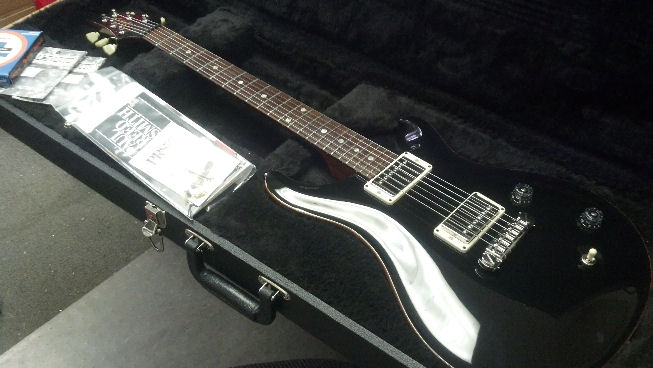
We had a big bag of parts and a guitar body in a case.  Let’s get to work!

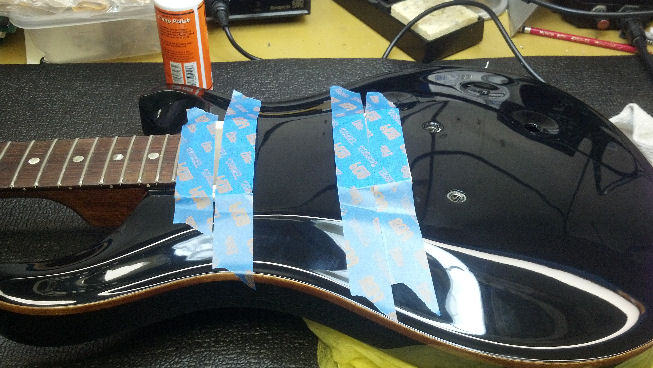
05CleanThreadsThe chip was touched up, then allowed to cure for a week.  Now, we’re protecting the finish of the guitar so that we can chase the threads in the insert.  I had considered just changing the inserts but didn’t want to take the risk at this point.

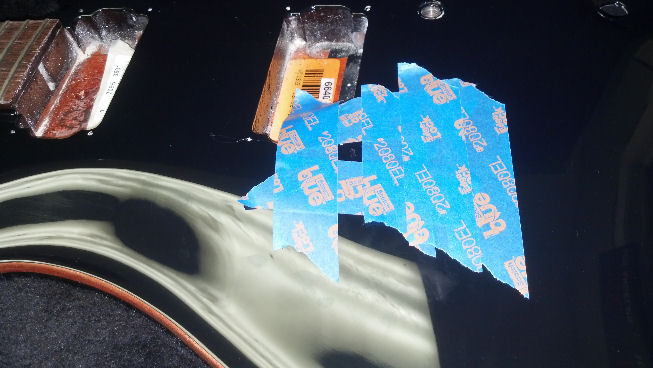
06TestThreadsAfter the threads were chased, a little bit of solvent was used to clear the bottom few threads.  Lots of protective, non-stick tape comes in handy when protecting a priceless guitar body!

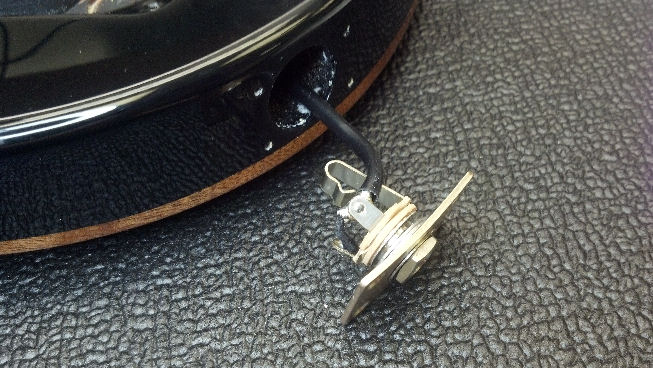
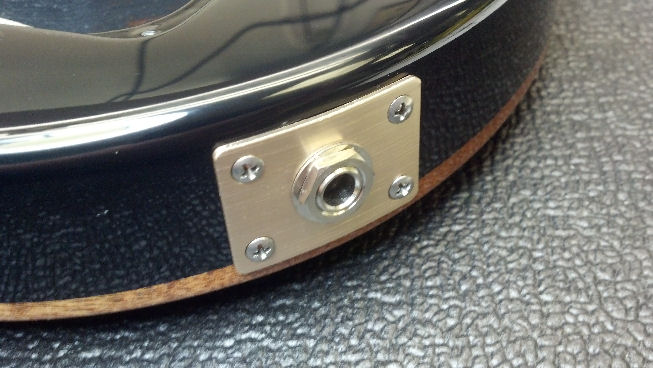
07AjackThis is a nice shot of the new pre-wired jack, already attached to the jack plate.  The cabling was pulled all the way into the internal routed cavities of the guitar, where it would be attached to the selector switch.

07BjackOops, there I did it again.  A little Guitar Tech Porn!  This is a nice setup, regardless of whether you are a tech or not.

07CjackAll squared away.  On to the pickups.

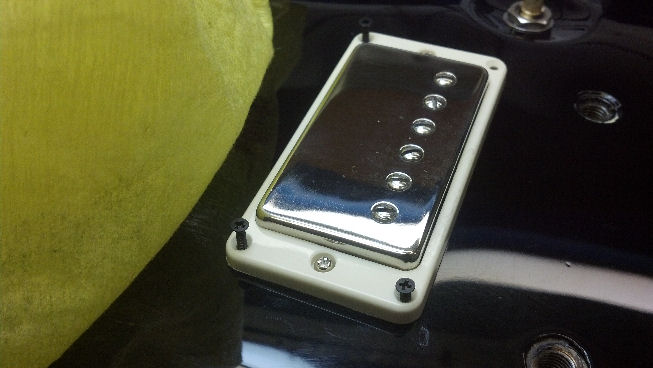
08PolishPickupsOriginally, I thought that the hardware for this guitar was nickel.  However, these were used pickups, and had years of funk on them.  I made the executive decision that these should be shiny, because the rest of the guitar was shiny.

09PickupAssyYeah, that’s what I’m talking about!  By the way, treble pickups go closest to the bridge, and bass pickups go near the neck.  Which begs the question, what are the middle pickups in a three-pickup-guitar called?  Grand Staff?

10TempHoldThe pickups were temporarily held in place with this no-mar tape while the guitar was turned over to do soldering on the routed compartment on the back side.

11Wiring1The wiring diagram says that the taps go to the push-pull pot.  I added some heat shrinkable tubing to all the solder joints I made.  Too bad the factory doesn’t do this, because accidental shorts would be one less thing to worry about.

11Wiring2Here, the switch is wired up with the output leads from each pickup per the wiring diagram.

12FinalAssyWith everything wired up and working, the pickups could be fastened down.  See my earlier Jazzmaster posts about the method I use to check guitar wiring without any strings attached to the guitar.

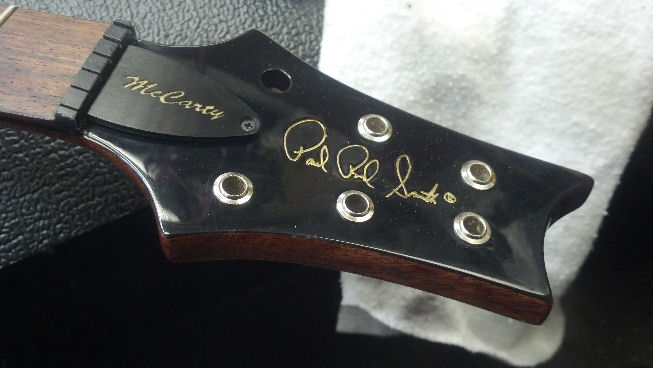
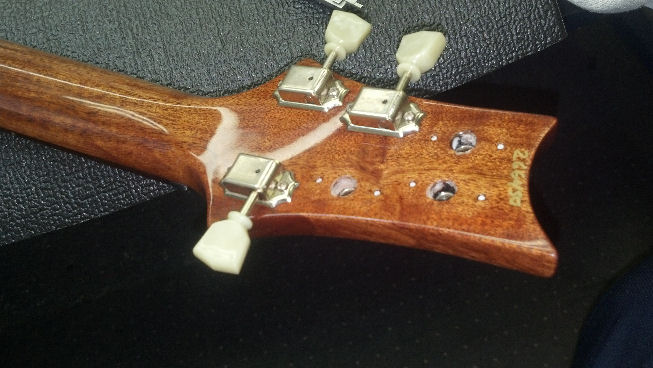
13AssembleTuners1And now, off to the headstock.  These bushings were too tight to fit into the holes because of the additional layer of paint.  Each hole was hand-reamed until the bushings could be pressed into place.

13AssembleTuners2These tulip tuners give a Kluson vintage look to the guitar.  I just love the mahogany wood!

13AssembleTuners3More Guitar Tech porn.  We’re done with the headstock.

14BridgeThis TonePros bridge is an intelligent upgrade for wrap-around bridges.  Here, I’ve run the individual saddles to the far end of each string, so that the vibrating part of the string will always be straight and not deformed because it once was bent over a saddle.  We’re ready for strings!

15DoneThis guitar has a beautiful voice, and the owner was pleased with the results!  Oops, more Guitar Tech Porn!


Thanks for reading all the way to the bottom of this post!

David Latchaw

281-636-8626